Writing software code is no longer a scarce or expensive activity. In fact, at scale, it now costs less than a fast food worker’s hourly wage. That sounds implausible until you separate coding from engineering and look at what autonomous AI systems are already doing today.
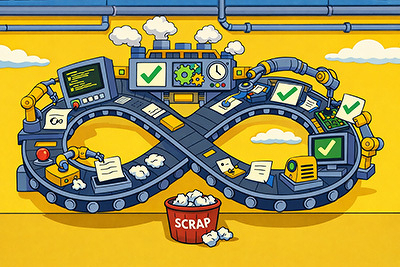
A technique called the Ralph Wiggum Loop is quietly reshaping how software gets made. Named after the persistent, never-give-up character from The Simpsons, it runs an AI coding agent in a simple loop, feeding it the same core prompt repeatedly until the job is done. No coffee breaks. No sleep. No complaints about the brief.
The idea has been pioneered by Aussie coder Geoffrey Huntley, who has been documenting the approach and its implications for the industry.
What it actually costs
In a recent video, Huntley laid out the economics with uncomfortable clarity.
“Essentially software development now costs US$10.42 an hour. It’s less than you would pay a fast food retail worker. It’s cheap. And not only is it cheap, you can do it autonomously.”
He bases these calculations on running Anthropic’s Sonnet 4.5 model via API in a loop over a 24-hour period. No human can code continuously for 24 hours straight. But a Ralph Wiggum Loop can. Huntley says that in a single hour of running these autonomous loops, you are outputting “multiple days worth of work, if not weeks levels of work.”
Development versus engineering
Huntley draws an important distinction here. Software development, in his framing, is the writing of code. Writing functions. Testing logic. Debugging errors. This is now largely an AI task.
Software engineering is something different: the high-level architecture, the maintenance of systems, the oversight of autonomous agents that generate the code. Humans are no longer the ones doing the manual labour. Huntley uses the analogy that software engineers are now “locomotive engineers” whose job is to “keep the locomotive on the track.”
The train does the heavy lifting. The software engineer’s job is to make sure it does not derail.
The disruption ahead
Huntley points to what is coming: a massive reduction in outsourcing and a devaluation of junior programmers. Developers need to upskill or be left behind.
But he cautions that the transition will not be easy.
“To get it working, you have to understand the bare bones fundamentals from first principles. Like don’t start with a jackhammer like Ralph. Like learn how to use a screwdriver first. Really important. Just don’t jump straight to the power tools.”
This is not a case of handing the keys to someone who has never driven. The opposite, actually. You need to understand coding deeply to supervise the machines doing it for you.
Garbage in, garbage out?
How will this play out? Will we see more software? Better software? Fewer jobs in the tech sector?
My read is that the grunt work will be commoditised, but the hard work of application design and software engineering will remain constrained by experience and human insight. The AI can code all night, but it cannot know what should be built or why it matters.
There is an old thought experiment called the Infinite Monkey Theorem: given enough time, a monkey hitting keys at random would eventually type the complete works of Shakespeare. The Ralph Wiggum Loop is not quite that. It is more like giving the monkey a good editor, a style guide and a deadline.
The output improves dramatically. But someone still needs to know what Shakespeare sounds like.
==
Glossary
AI Coding Agent A software system powered by a large language model that can write, modify, and reason about code, performing tasks such as implementation, refactoring, testing, and debugging with minimal or no human intervention.
API (Application Programming Interface) A programmatic interface that allows software to interact with external systems, including AI models, typically enabling automated and usage-based access.
Claude Code A coding-focused AI agent built on Anthropic’s Claude models, designed to assist with or autonomously perform code-generation tasks. There are now many competing alternatives by Claude Code widely still seen as leader.
Iterative Development A process of repeated refinement in which outputs are improved through successive cycles, each informed by feedback or evaluation.
Multi-Agent System An architecture in which multiple AI agents operate together, often with specialised roles such as coding, reviewing, testing, or refactoring.
Software Development In this context, the production of software code, increasingly automated and performed by AI systems.
Software Engineering The design, architecture, maintenance, and oversight of software systems, including the governance and supervision of autonomous AI workflows.