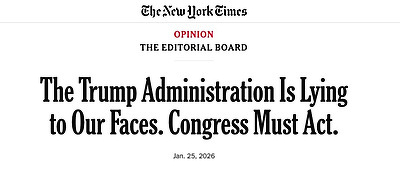
There is a sentence in Sunday’s New York Times editorial that deserves to be read slowly, then read again.
“Ms. Noem and Mr. Bovino are lying in defiance of obvious truths. They are lying in the manner of authoritarian regimes that require people to accept lies as a demonstration of power.”
That is the Editorial Board of the New York Times (not an op-ed columnist, not an outside contributor, but the institutional voice of the paper itself) stating plainly that the Secretary of Homeland Security and a senior Border Patrol official are lying. And not merely lying, but lying in a specific way: the way authoritarian governments lie.
This matters. It matters because major American newspapers have spent years tying themselves in knots to avoid the word “lie.” They have preferred “misstated,” “claimed without evidence,” “falsely asserted.” The conventions of objectivity have often meant treating obvious falsehoods as matters of contested interpretation. On Sunday, the Times abandoned that convention entirely.
The facts that prompted this are straightforward, if harrowing.
On Saturday morning in Minneapolis, Border Patrol agents shot and killed Alex Jeffrey Pretti. Within hours (before any investigation could plausibly have occurred) Homeland Security Secretary Kristi Noem declared that Pretti had “committed an act of domestic terrorism.” Gregory Bovino, a Border Patrol official, offered his own assessment: “This looks like a situation where an individual wanted to do maximum damage and massacre law enforcement.”
But there were videos. Multiple videos, recorded at the scene, showing something that contradicts the government’s account entirely.
The Times editorial lays it out:
“Those videos showed that Mr. Pretti had nothing but a phone in his hands when he was tackled by Border Patrol agents, and that he never drew the gun he was carrying (and reportedly had a license to carry). Indeed, the videos seem to show that one federal agent took the gun from Mr. Pretti moments before a different agent shot him from behind.”
The editorial notes that separate analyses by The New York Times, The Wall Street Journal, The Associated Press, CBS News and other organizations all reached the same conclusion: the videos contradict the administration’s description of the killing.
What the Editorial Board is naming here is not a dispute about interpretation. It is something starker.
“The administration is urging Americans to reject the evidence of their eyes and ears.”
That line carries a deliberate echo. George Orwell, in 1984, wrote: “The Party told you to reject the evidence of your eyes and ears. It was their final, most essential command.” The Times is drawing that parallel explicitly. When a government demands that citizens disbelieve what they can see with their own eyes, when video evidence is dismissed and the victim is posthumously labelled a terrorist without investigation, something fundamental has shifted.
The editorial also notes a grim pattern. Earlier this month, federal agents shot and killed another Minneapolis resident, Renee Good. In that case too, the administration demonised the victim and blocked state investigation.
There is a reason this editorial matters beyond its immediate subject.
For years, critics have argued that mainstream media’s commitment to “both sides” framing has left it incapable of naming lies as lies, even when the evidence is unambiguous. The fear of appearing partisan has often trumped the obligation to be truthful. Sunday’s editorial represents something different: an institutional decision that some moments require clarity over caution.
The Times is not hedging. It is not presenting the administration’s claims and the video evidence as two equally valid perspectives. It is stating, as plainly as the English language allows, that government officials are lying to the public’s face, and that this lying has a particular character and purpose.
“They are lying in the manner of authoritarian regimes that require people to accept lies as a demonstration of power.”
That sentence will either be remembered as the moment American journalism found its voice, or as a warning that went unheeded. Either way, it deserves to be read.