Every programmer knows the code rewrite conversation. The codebase has drifted. Security vulnerabilities are piling up. The platform you’re running on is three versions behind. It needs fixing, but nobody wants to touch it.
The economics are brutal. Thousands of hours rewriting working code to do exactly what it already does. Management looks at the spreadsheet and sees massive cost with zero new features. Engineers look at the backlog and wonder why they signed up to translate code line by line when they could be building something new.
This is where agentic AI tools are starting to shift the calculation.
SmartFriend™️ Peter’s weekend project
Peter Marks, who writes at marxy.org, recently documented his experience porting FreeDV RADE v1 from Python to C. FreeDV is digital voice software for amateur radio. The Python implementation works, but C “would make it easier to install, smaller, and hopefully more efficient”.
The conventional wisdom says this kind of port takes weeks. Peter used AI tools to accelerate the translation, documented the process and shared both the successes and the limitations. Peter says what would have taken months has instead been delivered in days across a few sessions.
Microsoft’s billion-line bet
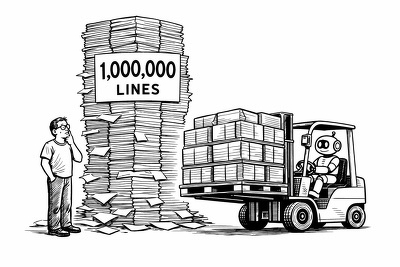
Microsoft Distinguished Engineer Galen Hunt declared his goal in December 2025: “eliminate every line of C and C++ from Microsoft by 2030.” The target metric is one engineer, one month, one million lines of code.
Microsoft is building infrastructure to map source code at scale, then apply AI-guided modifications across millions of lines at a time. The primary target is translating C and C++ systems to Rust, eliminating entire categories of memory safety bugs. More than 70% of vulnerabilities in Microsoft products trace back to memory safety issues that Rust makes structurally impossible.
This is research infrastructure, not a Windows rewrite. The project sits within Microsoft’s Future of Scalable Software Engineering group with a mandate to remove technical debt at scale.
Why this matters
The economics of code rewrites have shifted. Doing nothing compounds technical debt and security exposure. Doing the work manually has been prohibitive. Engineers don’t get into the field to be human compilers.
AI tools change the calculation. Peter’s experience shows the pattern: AI handles mechanical translation, humans handle judgement calls. Microsoft’s infrastructure suggests this scales to enterprise codebases. The grunt work of translation is becoming automatable.
The bottleneck shifts from transcription to architectural judgement. That is better use of engineering talent.
If you’re sitting on legacy code that needs modernising, the calculation just changed. The question is no longer whether to migrate, but whether to do it now or wait until the debt becomes unmanageable.
The dirty work nobody wanted to do is becoming the work that finally gets done.
Sources:
- Experimental C port of FreeDV RADE v1 - Peter Marks, marxy.org (blog.marxy.org)
- Microsoft wants to replace its entire C and C++ codebase - The Register (theregister.com)
- Microsoft building team to eliminate C and C++ - Windows Latest (windowslatest.com)
- Microsoft’s Bold Goal: Replace 1B Lines of C/C++ With Rust - The New Stack (thenewstack.io)