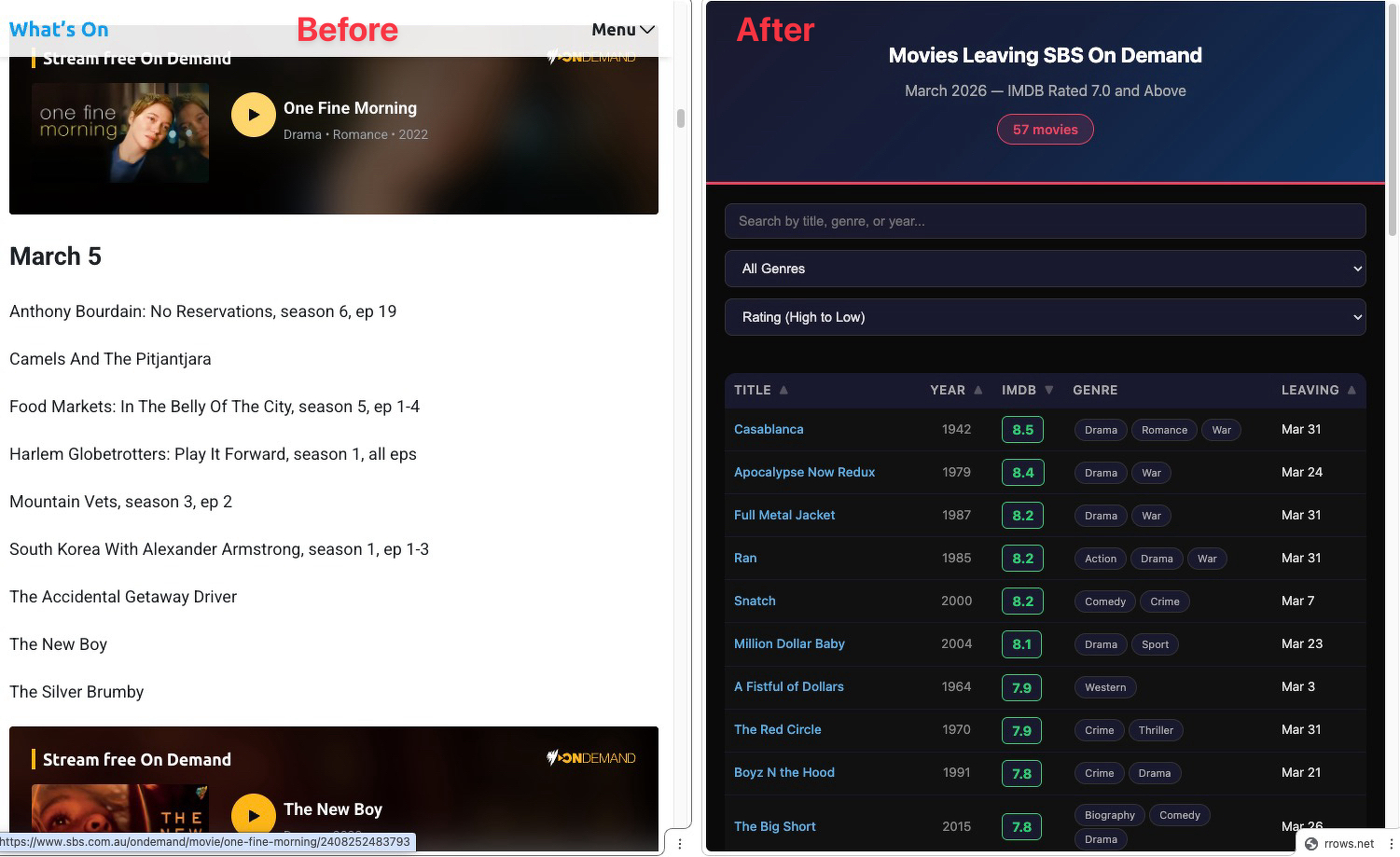
Australia’s SBS ‘tv channel’ publishes a monthly “what’s leaving” list. It’s a wall of text. Series, movies, documentaries and specials jumbled together with no ratings, no genres and no way to tell whether something is worth your Friday night or a waste of two hours. The March 2026 list runs to over 200 items.
I wanted one thing: which movies leaving SBS this month are actually good?
Not series (I’ll decide those on my own terms). Not everything rated above average. Movies rated 7.0 or higher on IMDB. A curated shortlist with links, ratings and leaving dates so I could plan what to watch before it disappeared.
So I asked Claude Cowork to do it.
What SBS gives you
The SBS “What’s Leaving” page is organised by date. Each day lists everything expiring, from Anthony Bourdain episodes to Casablanca. There’s no filtering. No distinction between a single documentary and season 14 of Hoarders. No quality signal at all.
March 2026 has roughly 200 items spread across 31 days, with a massive dump on March 31 that alone contains over 100 titles. Buried in there are Kurosawa’s Ran, Bresson’s Pickpocket, Melville’s The Red Circle and Full Metal Jacket. Also buried: Norbit, Glitter and Lake Placid.
The signal-to-noise ratio is terrible.
What I asked for
The brief to Claude Cowork was specific. Visit the SBS page. Extract every title. Exclude anything marked with “season” or “ep” (the series indicators). For every remaining title, check the IMDB rating. Return only those scoring 7.0 or above, with the movie name, IMDB link, rating and the date it leaves SBS.
Then turn the result into a shareable HTML page.
What happened next
Claude loaded the SBS page in the browser, extracted the full list and immediately began filtering. Series identification was straightforward: any title followed by “season X, ep Y” got excluded. That stripped roughly half the list.
The remaining ~150 titles needed IMDB verification. This is where it got interesting. Rather than checking each movie one at a time (which would have taken ages), Claude launched six parallel search agents, each handling a batch of 25 or so titles simultaneously. Every title got a web search against IMDB, pulling the rating and URL.
The whole process, from loading the SBS page to delivering a compiled, sorted list of 57 qualifying movies, took roughly four minutes.
Four minutes to process 200+ items, filter out series, cross-reference 150 movies against IMDB (International Movie Data Base) and compile the results. Doing this manually would have taken the better part of an evening.
The result
57 movies rated 7.0 or above are leaving SBS On Demand in March 2026. The range is remarkable. You’ve got Casablanca (8.5) and Apocalypse Now (8.4) at the top. Kubrick, Kurosawa, Tarantino and Bresson in the mix. Indian cinema (Bheeshma Parvam, Malikappuram, Village Rockstars). Iranian new wave (Chess of the Wind). Algerian history (Chronicle of the Years of Fire). Senegalese drama (Black Girl). Australian stories (Mabo: Life of an Island Man, Priscilla Queen of the Desert).
SBS’s international catalogue is genuinely impressive when you strip away the noise.
The final HTML page is sortable by rating, date, title or year, has genre filtering and a search bar. Every title links directly to its IMDB page. It’s very clever. I wish I could claim credit but it’s all the work of Claude Cowork.
Why this matters beyond my watchlist
This is a small example of something that’s becoming routine. The task wasn’t hard conceptually. Anyone could do it manually. But manually means opening IMDB 150 times, copying ratings, building a spreadsheet and formatting the output. It’s the kind of task that’s just tedious enough that nobody actually does it.
Agentic AI collapses that friction. The interesting part isn’t that Claude can search IMDB. It’s the orchestration: parsing an unstructured web page, making filtering decisions, parallelising 150 lookups across multiple agents and compiling the output into a usable format. All from a single natural language request.
The limiting factor, as I keep finding, is knowing what to ask for. The execution is essentially free.
PS: Here’s the final smart list in a light theme (my preference).
Sources:
- SBS What’s Leaving March 2026 (sbs.com.au)
- IMDB (imdb.com)