Honda just wrote down $15.7 billion on its EV strategy. Cancelled three models months before launch. Flagged its first annual loss in nearly 70 years as a listed company. The Honda 0 Saloon, 0 SUV and Acura RSX are dead. The Ohio EV hub that was supposed to build them sits waiting for a purpose.
It is a staggering number. But it is not surprising.
Honda bet heavily on the US market for its electric future. Then the One Big Beautiful Bill Act killed federal EV tax credits, replacing them with interest deductions for US-made cars. The business case for Honda’s planned EV imports evaporated overnight. CEO Toshihiro Mibe admitted “the situation changed far more rapidly than we expected.” Battery-powered cars accounted for just 2.5% of Honda’s 3.4 million global sales last year. They were never close to ready.
Honda is not alone. Stellantis has taken $26 billion in EV-related charges. Ford, $19.5 billion. GM, $6 billion. The industry tally is approaching $67 billion and climbing. These are companies that poured capital into a transition they believed was imminent, in a market that turned out to be the wrong one to bet on.
We have seen this before
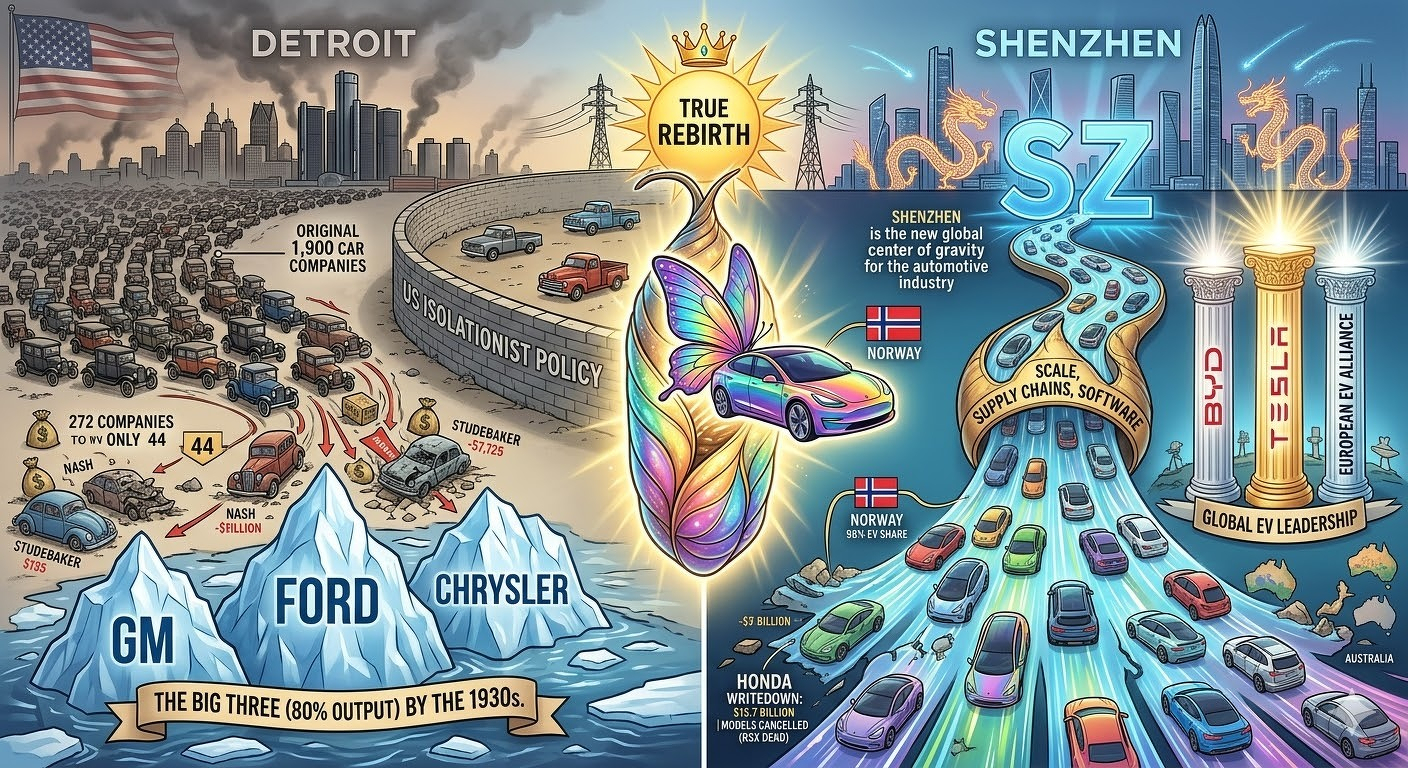
At the turn of the 20th century, around 1,900 different companies formed to build automobiles in the United States. The peak came in 1909, when 272 automakers were actively operating. Thirty companies produced 2,500 vehicles in 1899. By 1920, output had exploded to nearly two million units annually.
Then consolidation hit. By the time General Motors surpassed Ford in 1927, the number of American car manufacturers had shrunk to just 44, down from 253 in 1908 and 88 as recently as 1921. The Big Three (GM, Ford, Chrysler) accounted for roughly 80% of all output by the end of the decade. A decade later, fewer than 12 remained. By the 1950s, the independents (Nash, Hudson, Studebaker, Packard) were gone entirely.
The EV era is replaying this pattern at speed.
China once had approximately 500 electric car manufacturers. That number has already collapsed to around 68 active brands. The top ten now control 95% of the market, up from 60-70% just two or three years ago. BYD dominates. Factories are running at 50% utilisation despite producing over 27 million vehicles annually, more than double domestic demand. A brutal price war has slashed average profit margins to 3.9%. Brands like Aiways and Singulato have already folded. More will follow.
The current explosion of EV brands will not be sustained. The economics of scale are ruthless. They were in 1920 and they are now.
The US is a weird exception
The best-selling “car” in America is the Ford F-150 light truck. The F-Series has held that title for 49 consecutive years. It was the most popular vehicle in 29 of 50 states in 2025. Most of America’s best-selling local brands would not sell at all well in most other parts of the world. Huge pickups, oversized SUVs, vehicles optimised for cheap petrol and long highway miles.
Trump’s policy reversal on EV subsidies has made this exceptionalism sharper. The US is now actively hostile to the EV transition through policy choices. That is a decision the rest of the world does not need to follow, and largely is not following.
Honda’s mistake was focusing too hard on this market.
For the rest of the world, the future is EV
Norway hit 95.9% battery electric vehicle share for full year 2025. December touched 97.6%. Pure diesel accounted for 1%. Petrol, 0.3%. The internal combustion engine is functionally dead in Norway’s new car market. Chinese brands took 13.7% of Norwegian sales, up from 10.4% the previous year.
Australia is much earlier on the curve. BEVs made up 8.3% of new car sales in 2025, up from 7.4% in 2024. That puts us roughly where Europe was in 2021-2022. But the trajectory is accelerating. December 2025 hit a record 16.7% EV share in a single month. Early 2026 data shows year-to-date BEV sales up roughly 50% on the same period last year. February 2026 was the first month China overtook Japan as the largest source of new vehicles sold in Australia, with Chinese-built vehicles up 45% year-on-year.
The question is not whether EVs take over. It is how fast.
China is playing the long game
Europe is where the real battle is unfolding. Chinese battery electric vehicles now capture 9.6% of the European market, up from 5% five years ago, despite EU tariffs imposed in October 2024. Chinese car brands sell more cars in Europe than Audi or Renault. BYD is building a factory in Hungary, due to begin production in 2026, which will allow it to avoid tariffs entirely. Chinese automakers are targeting 20% of the European EV market by 2027.
Meanwhile, German carmakers are losing ground in China itself. Volkswagen’s sales dropped 8% in 2025. Mercedes-Benz fell 19%. BMW, 12.5%. These companies are being squeezed from both directions: losing their most profitable export market while facing an invasion in their home territory.
European brands are at serious long-term risk. Chinese manufacturers have shorter development cycles, stronger software capabilities and relentless cost discipline. XPeng CEO He Xiaopeng warned that “competition in 2026 will be even more brutal and bloody.” He is probably right.
The shakeout is coming
The parallels with the early American auto industry are instructive. A flood of manufacturers, driven by transformative new technology. Massive capital investment. Enormous consumer enthusiasm. Then the economics of mass production assert themselves and the field narrows violently.
We are watching the rebirth of the car industry. The technology has changed from internal combustion to electric. The centre of gravity has shifted from Detroit to Shenzhen. But the pattern is the same. Too many companies, not enough margin, and the survivors will be those who master scale, supply chains and software.
Honda’s $15.7 billion write-off is not the end of this story. It is the opening chapter.
Sources:
- Reuters via Investing.com (investing.com/news/stock-market-news/hondas-157-billion-ev-writedown-is-painful-but-china-challenges-loom-down-the-road-4561587)
- CNBC: Honda flags first annual loss (cnbc.com/2026/03/13/honda-flags-first-annual-loss-hit-by-15point7-billion-ev-charge.html)
- Electrek: Honda scraps three EVs (electrek.co/2026/03/12/honda-scraps-three-most-important-evs-us/)
- Electric Vehicle Council Australia (electricvehiclecouncil.com.au)
- CNBC: Norway 96% electric (cnbc.com/2026/01/02/evs-norway-new-car-sales-hit-96percent-electric-in-2025-as-tesla-dominates.html)
- The Driven: Australia EV sales 2026 (thedriven.io/2026/03/04/ev-sales-bounce-back-to-nearly-12-pct-of-australia-market/)
- Rest of World: Chinese EV exports (restofworld.org/2026/china-ev-exports-competition-price/)
- Merics: China’s EV makers target Europe (merics.org/en/report/drivers-seat-chinas-electric-vehicle-makers-target-europe)
- Ford Authority: F-150 best-selling (fordauthority.com/2026/02/ford-f-150-most-popular-vehicle-of-2025-in-majority-of-u-s-states/)
- EBSCO: Number of US Automakers Falls to Forty-Four (ebsco.com/research-starters/history/number-us-automakers-falls-forty-four)