I don’t watch reality TV. I find most of it unwatchable. The one exception is talent shows, and I’ve never fully understood why they hook me.
It could be the Brian Epstein* fantasy. Sitting on the couch, playing talent scout, wondering if I’d have spotted the next big thing before the industry machine gets hold of them. It could be the raw, unpolished performances before a producer smooths every edge away. It could be that I have zero performing arts talent myself. (I’m fairly confident I could resolve the Middle East conflict by threatening to sing.)
No matter. It hooks me.
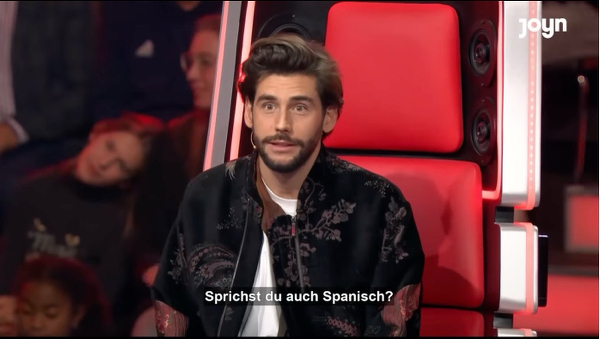
Then along comes Pablo. A Spanish kid, performing on The Voice Kids Germany. He walks out and sings a French song. To my admittedly untrained ear, his French is glorious. The judges turn their chairs. And then the real show begins.
The coaches start speaking to him in German. Pablo responds fluently. Then Álvaro Soler, the Spanish-German coach, switches to Spanish and the two of them are off, rattling away with the occasional English phrase thrown in for good measure. The other coaches follow along, code-switching between languages like it’s nothing.
I struggle at times with my native English. Watching a kid navigate three languages on live television while the adults around him casually toss in a fourth was quietly humbling.
And then the tech angle caught my attention.
I tried Apple’s AirPods Pro live translate feature to follow the German and Spanish segments. It was slow and it missed a lot of the nuance. The translation would arrive seconds after the moment had passed, stripped of context and tone. For a feature Apple has been pushing hard, it felt half-baked in a real-world scenario with fast, emotional conversation.
Then I remembered YouTube’s auto-translate subtitles. Switched them on and the German-to-English was excellent. Near-instant, contextually accurate, capturing the warmth of the judges' comments. It handled the rapid back-and-forth between coaches without breaking a sweat.
Until it hit Spanish.
When Soler switched to Spanish to chat with Pablo, the subtitles stumbled. They caught fragments but lost the thread. Not quite as fluid as the European language geniuses on screen, but given it was handling real-time multilingual audio with no prior context about which language was coming next, still impressive.
The gap between Apple’s hardware-based translation and YouTube’s cloud-based subtitles was stark. One is trying to be magical and falling short. The other just quietly works, most of the time, with known limitations. There’s a product lesson in there somewhere.
But the real story is Pablo. A kid who hasn’t been focus-grouped or media-trained, standing on a stage in a country that isn’t his, singing in a language that isn’t his or theirs, and then charming everyone in the room in their own tongue. That’s the kind of raw, unmanufactured moment that keeps me coming back to talent shows. Yes, it’s often obvious how the producers pre-screen talent to help milk emotions, but there’s no hiding the real talent when it emerges.
- Epstein was the successful manager of The Beatles who helped them break out of Liverpool and become a global phenomenon. I enjoyed the recent biopic Midas Man (2024) which covered his influence in getting the band signed and their early success. Pity Epstein died young while The Beatles were still soaring.