Wall Street has a name for it. They call it the TACO trade: Trump Always Chickens Out. The idea is simple. Trump announces something extreme, markets panic, he reverses course, markets rally. Traders who bet on the reversal clean up. It’s been reliable enough that Fortune, CNN and Bloomberg have all written it up as a repeatable strategy.
But TACO misses the point. Chickening out implies weakness, indecision, a man backing down. That framing is charitable. What if the pattern isn’t about losing nerve at all?
What if the pattern is about making money?
I want to propose a different acronym. TACI: Trump Always Cashes In.
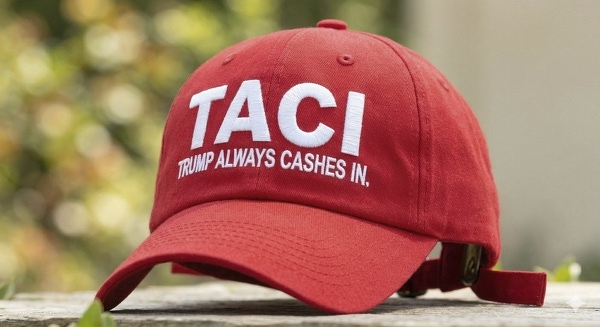
The evidence is mounting across three distinct financial channels: market-moving announcements with suspicious pre-knowledge, unprecedented government “success fees” from brokered corporate deals, and direct presidential control over billions in foreign oil revenue held in offshore accounts. Each one is extraordinary on its own. Together, they describe something that looks less like policy and more like a business model.
The 5-day ceasefire that made $1.7 trillion appear
On the morning of 23 March 2026, Trump posted on Truth Social in his trademark all-caps style. The US and Iran had held “very good and productive conversations.” He was postponing military strikes on Iranian power plants for five days. A “complete and total resolution” was at hand.
Markets moved instantly.
The S&P 500 jumped 1.15%. The Dow gained 631 points. The Nasdaq surged 1.38%. Collectively, $1.7 trillion in equity value materialised in minutes.
Oil cratered. WTI crude dropped from $113 to around $91 per barrel. Brent fell from above $114 to around $104. Gold swung $300 in a single session. Bitcoin ripped 5% to $71,000. The Trump memecoin jumped 20-30%.
Iran immediately denied any talks were happening. Their foreign ministry spokesperson, Bagher Ghalibaf, was blunt: Trump was attempting to “manipulate the financial and oil markets."
27 minutes after the announcement, Iran had denied everything. But by then, the money had already moved.
The wallets that woke up on Sunday
Here’s where it gets pointed.
On Sunday 22 March (the day before the public announcement), 10 brand-new wallets appeared on Polymarket, the crypto prediction platform. They had zero prior transaction history. They were all created at the same time. They placed coordinated, simultaneous bets totalling $160,000 on a ceasefire by end of March.
Potential payout: over $1 million.
Polymarket responded by updating its insider trading rules on the same day the announcement went public. The new rules explicitly prohibit acting on stolen confidential information, wagering on illegal tips and betting if you’re in a position to influence the outcome. You don’t rewrite your rules at that speed unless something has gone very wrong.
This wasn’t the first time. Earlier reporting documented traders making $1.2 million on insider information about US military strikes. A separate crypto whale dropped $2.2 million on Trump memecoins ten days before the ceasefire announcement, netting $2.5 million in profit within hours.
It’s worth noting that Donald Trump Jr is an adviser and investor in Polymarket. Democrats have alleged Trump family members profited from bets that appeared to foresee US military strikes in the Middle East, suggesting access to classified planning.
Speculative connection: the prediction market investments, the memecoin positions and the policy announcements form a triangle. No prosecution has established direct coordination, but the circumstantial pattern is persistent and growing.
The precedent: “THIS IS A GREAT TIME TO BUY!!!”
The March 2026 ceasefire isn’t an isolated event. It’s an escalation of a pattern that started in April 2025.
On 2 April 2025, Trump announced sweeping tariffs. China at 54%. EU at 20%. Vietnam at 46%. The S&P 500 fell 12%. The Dow lost 4,600 points. Roughly $5 trillion in market value evaporated over four days.
Then, at 9:37am on 9 April, Trump posted on Truth Social: “BE COOL! Everything is going to work out well." Followed by: “THIS IS A GREAT TIME TO BUY!!!"
Less than four hours later, he announced a 90-day tariff pause. The Nasdaq surged 12.2%. The S&P jumped 9.5%. The Dow gained 7.87%, its best day since 2008.
Call options on S&P 500 ETFs showed suspicious volume spikes 15-20 minutes before the tariff pause announcement. Options traders made $30 million overnight. One trader purchased $2.2 million in Nasdaq calls that surged over 2,000% within an hour.
Senate Democrats called for an SEC investigation. The SEC, which operates under the Trump-controlled executive branch, has not launched one.
The $10 billion TikTok fee
If the market manipulation pattern is the trading floor of TACI, the TikTok deal is the back office.
The deal closed on 22 January 2026. A consortium led by Oracle, Silver Lake and Abu Dhabi’s MGX acquired a majority stake in TikTok’s US operations, with ByteDance retaining 19.9%. The company was valued at approximately $14 billion.
The Trump administration extracted a “success fee” of $10 billion. An initial $2.5 billion was paid at closing, with the remainder due in instalments.
Let that number sink in. $10B on a $14B deal = 71%.
Standard investment banking advisory fees for M&A transactions run under 1% of deal value. This fee is 71 times that. Senator Mark Warner called it a “shakedown scheme” with “no analogue in modern American history."
Warner’s formal letter to Treasury Secretary Scott Bessent on 17 March 2026 asked directly whether Trump requested any portion of the fee for himself, his family or affiliated businesses. The letter states the arrangement “would continue a pattern set by the Trump administration of exercising the power and authority of the government to benefit certain companies and individuals close to the President, and to extract financial concessions as a condition of doing so.”
The primary beneficiary is Larry Ellison’s Oracle. Ellison previously hosted $100,000-per-person Trump fundraisers. His family now controls CBS through Paramount and is pursuing a Warner Bros acquisition that requires Trump administration approval. The incentive structure is circular.
The Public Integrity Project filed suit in March 2026, alleging the deal violates the 2024 law designed to prevent Chinese government propaganda, enriched Trump’s allies, and that Trump directed AG Pam Bondi not to follow the law. They allege Trump granted five separate illegal extensions where the law permitted only one. ByteDance still owns TikTok’s critical algorithm. ByteDance still manages key US operations.
The national security justification for the entire exercise has been hollowed out. What remains is a $10 billion payment extracted from private investors under government duress, flowing to accounts controlled by the executive branch, with no congressional appropriation or oversight mechanism.
The Venezuelan oil slush fund
The third channel is the most brazen.
Following the January 2026 capture of Nicolás Maduro, the Trump administration established direct control over Venezuelan oil sales. Trump stated publicly that he would personally control the revenue from these sales.
Treasury’s OFAC issued general licences allowing US firms to market Venezuelan crude globally. Up to 50 million barrels. All proceeds must flow through US-controlled accounts rather than to PDVSA. Venezuela’s government must submit budgets for US approval before funds are released.
The first $500 million went to a bank account in Qatar.
Not the US Treasury. Qatar. Described as a “neutral location.” The justification was that US bank accounts might be frozen by creditors. Energy Secretary Chris Wright later announced funds would be redirected to a US Treasury account, but by then two-thirds of the initial tranche had already been transferred to Venezuelan banks with the remainder sitting in Doha.
The Cato Institute raised constitutional concerns under the Miscellaneous Receipts Act, which mandates government money goes to the Treasury. Democratic senators launched investigations demanding bank records. Schiff and Schumer introduced the Venezuela Oil Proceeds Transparency Act requiring a GAO audit.
But the details of the oil trading are where TACI really shows its teeth.
The first $500 million sale was awarded to Vitol, where senior trader John Addison donated $6 million to Trump’s 2024 campaign. Addison attended a White House meeting with Trump personally. Both Vitol and Trafigura received initial licences, purchasing Venezuelan crude at $15 per barrel below market and reselling at $6-7 per barrel margins.
Both firms have prior bribery prosecutions in oil transactions. They were selected anyway.
By February 2026, total Venezuelan oil sales exceeded $1 billion. An additional $5 billion in contracts is expected over coming months. The president has created, functionally, a multi-billion dollar revenue stream under direct executive control, flowing initially through offshore accounts, with commodity trades awarded to his campaign donors at below-market prices.
Speculative connection: the combination of offshore accounts, donor-awarded trades and presidential claims of personal control creates an opacity layer that would be familiar to anyone who has studied kleptocratic resource extraction. No evidence of direct personal enrichment has been publicly proven, but the architecture enables it.
The unified theory
TACI isn’t about one scandal. It’s about a system.
Channel 1: Market manipulation. Policy announcements (tariffs, ceasefires, military strikes) create predictable market swings. Insiders with advance knowledge position themselves in equities, options, crypto and prediction markets. The Trump memecoin alone generated $3.9 billion in retail losses while 58 wallets made $10+ million each. Family members advise the prediction platforms. No SEC investigation has been launched.
Channel 2: Government fees. The TikTok deal demonstrates that the administration will extract payments from private parties as a condition of regulatory action. $10 billion on a $14 billion deal, with no legal framework, no competitive process, no congressional oversight. The money flows to Treasury accounts controlled by the executive.
Channel 3: Resource extraction. Venezuelan oil revenues flow through offshore accounts before reaching any US institution. Commodity trades are awarded to campaign donors at below-market rates. The president claims personal control over the funds. Constitutional oversight mechanisms are being actively resisted.
The connecting tissue is control without accountability. Each channel generates enormous financial flows. Each channel has inadequate oversight. Each channel benefits Trump’s personal financial ecosystem, whether through memecoin holdings, donor relationships, allied business interests or direct executive authority over cash.
The fired inspectors general. The neutered SEC. The compliant Attorney General who sold her Trump Media shares on Liberation Day. These aren’t separate stories. They’re the infrastructure of TACI.
ProPublica’s March 2026 release of 3,200 financial disclosure records revealed the scale: Deputy Secretary of Defense Steve Feinberg overseeing $151 billion in contracts while maintaining financial ties to portfolio companies winning those contracts. Deputy AG Todd Blanche holding up to $485,000 in crypto while issuing memos curtailing federal crypto investigations. Conflicts of interest aren’t bugs in this system. They’re features.
The TACO framing gave Wall Street a cute trade. Buy the dip, sell the rip, repeat. But it normalised something far more serious by treating it as comedy.
TACI is the corrective. The pattern isn’t a president who talks tough and backs down. It’s a president who has built three parallel financial channels, each generating billions, each lacking oversight, each benefiting his personal network.
The 5-day ceasefire wasn’t diplomacy. The TikTok fee wasn’t policy. The Venezuelan oil account wasn’t nation-building.
Trump always cashes in. That’s the theory. The evidence is getting hard to ignore.
Sources:
- Trump has TACO’d again, sparking a $1.7 trillion stock market rally (fortune.com)
- Trump postpones military strikes on Iranian power plants for five days (aljazeera.com)
- Trump says the US is in talks with Iran, which Iran denies (npr.org)
- Polymarket sees coordinated buying on early US-Iran ceasefire contracts (coinspectator.com)
- Polymarket updates insider trading rules following scrutiny (bloomberg.com)
- Trump told investors to ‘buy’ hours before tariff pause (pbs.org)
- Why some are accusing Trump of manipulating stock markets (npr.org)
- Warner demands answers on $10 billion TikTok deal (warner.senate.gov)
- TikTok deal lawsuit against Trump and Bondi (npr.org)
- US to receive $10 billion fee from TikTok deal (finance.yahoo.com)
- Trump’s “I’ll control the money” Venezuela oil claim (cato.org)
- Trump Venezuela oil awarded to Vitol and Trafigura (washingtonpost.com)
- Schiff and Schumer demand audit of Venezuela oil money (schiff.senate.gov)
- Trump family bets on prediction markets (cnn.com)
- Was Trump’s Iran announcement just market manipulation? (newrepublic.com)
- ProPublica: Trump appointee financial disclosures (propublica.org)
- House Judiciary: Trump family crypto empire report (democrats-judiciary.house.gov)
- Warren, Schumer call for SEC insider trading investigation (banking.senate.gov)