Tey Bannerman tried to explain to someone what Microsoft Copilot is. He couldn’t. Because the name now refers to at least 78 separate products and tools. There are Copilots inside Copilots. Copilots for other Copilots. A physical key on your keyboard for summoning them. And a tool for building more Copilots.
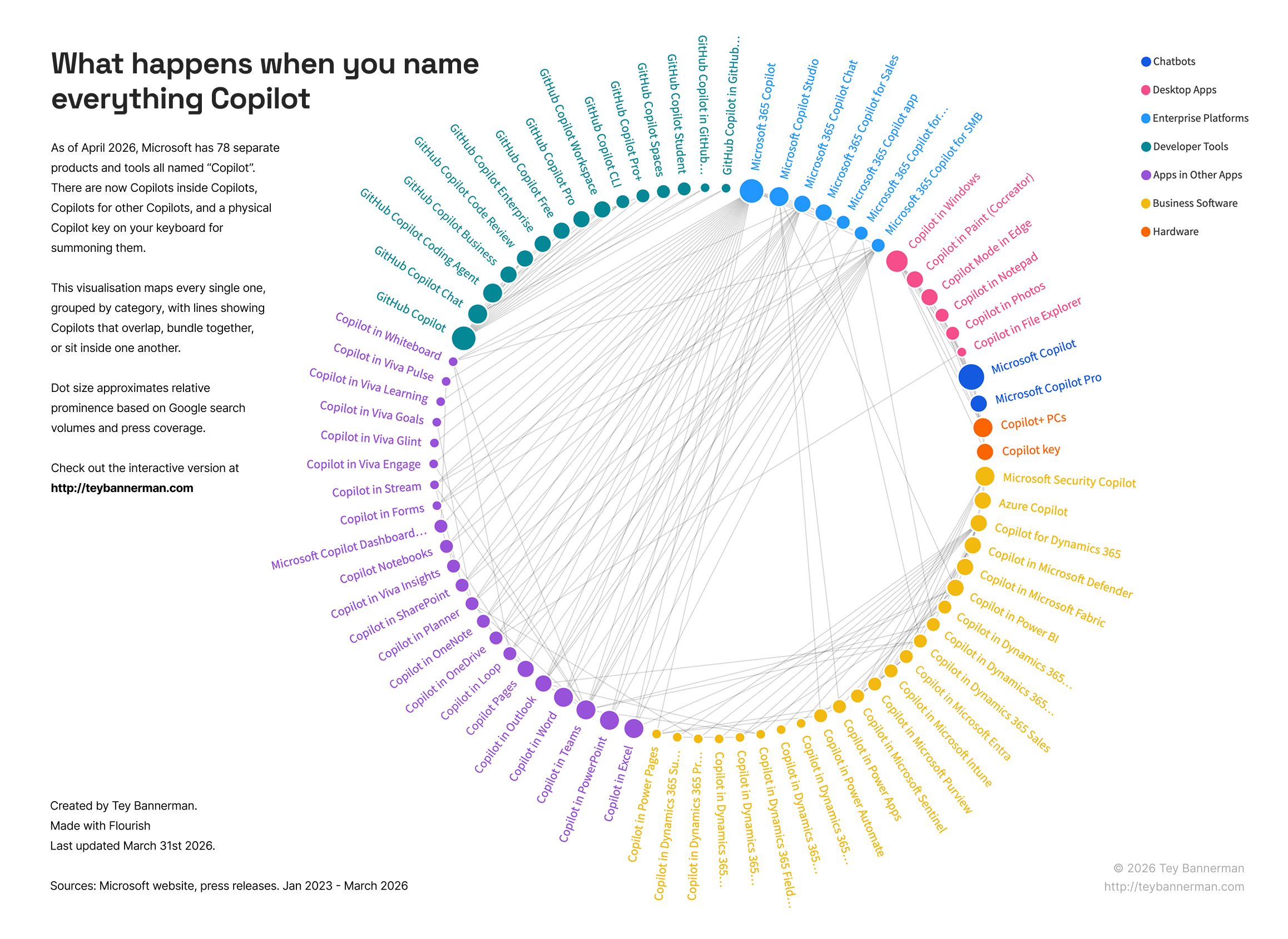
Visualisation by Tey Bannerman. Interactive version at teybannerman.com.
This is not new behaviour. Microsoft has a long and reliable habit of grabbing a product name that tests well and smearing it across everything until it means nothing.
They did it with .NET. What started as a development framework became a branding exercise. We got .NET Passport, .NET My Services, .NET Server, .NET Enterprise Servers. For a while, Windows itself was going to be rebranded. The name became so diluted that Microsoft quietly walked most of it back, and .NET returned to meaning what it should have meant all along: a developer platform.
Then it was Live. Windows Live Mail. Windows Live Messenger. Windows Live Photo Gallery. Windows Live Movie Maker. Windows Live OneCare (an antivirus, somehow). The word “Live” was bolted onto anything that touched the internet, which by 2008 was everything. The brand collapsed under its own weight.
Outlook might be the most instructive example. Microsoft took a respected enterprise brand and force-fitted it onto every email-adjacent product they shipped. Outlook: the powerful desktop app. Outlook.com: the webmail service that replaced Hotmail. Outlook Express: a completely unrelated lightweight client from the XP days. Outlook “New”: the current web-based replacement for Windows Mail. Telling someone to “open Outlook” now requires a 10-minute technical interview to establish which one they actually have.
Copilot is the same pattern at a larger scale. 78 products across chatbots, desktop apps, enterprise platforms, developer tools, business software and hardware. No single source lists them all. Not even Microsoft’s own documentation.
The instinct is understandable. You have a brand that resonates, and you want everything to benefit from it. But there’s a point where ubiquity becomes confusion, and confusion becomes a support cost. When your customers can’t describe what they’re using without qualifying it with three extra words, you’ve overshot.
Bannerman’s visualisation makes the absurdity tangible. It’s worth a look.
Sources:
- How many Microsoft Copilots are there? (teybannerman.com)