They’re home.
At 8:07 p.m. EDT on Friday, the Orion capsule carrying four astronauts splashed down in the Pacific Ocean off San Diego, completing a ten-day journey of nearly 1.1 million kilometres. Artemis II is the first crewed flight beyond low Earth orbit since Apollo 17 in 1972. More than half a century between drinks.
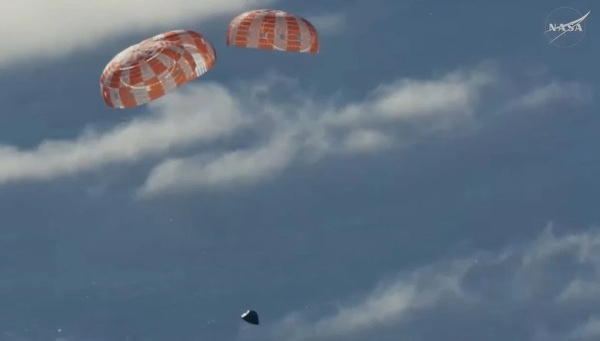
The relief is enormous. Not because there was any specific expectation of failure, but because space remains unforgiving and this mission carried weight far beyond its flight plan. The crew broke the all-time distance record at 400,171 km from Earth, surpassing a mark set by Apollo 13 in 1970. They tested systems that will eventually land humans on the lunar surface. And they did it flawlessly.
Here is what NASA will not say loudly enough: Victor Glover is the first Black person to fly to the Moon. Christina Koch is the first woman. Jeremy Hansen is the first non-American. Reid Wiseman, at 49, the oldest. This crew represents something genuinely remarkable, and the agency responsible for assembling it has been actively scrubbing that significance from its own website.
NASA once proudly stated its Artemis goal was to land “the first woman and first person of colour” on the Moon. That language has been deleted, swept away by executive order in the broader federal purge of anything resembling diversity, equity and inclusion. The milestones still happened. The history is still made. But the organisation that achieved it now acts as though acknowledging the achievement is somehow embarrassing.
NASA is an engineering and science organisation, not a political one. Nobody expects rocket scientists to wave banners. But quietly deleting your own history because the political wind shifted is a disservice to the people who made it.
These are not token appointments. Glover is a former Navy captain and test pilot who previously served on a long-duration ISS mission. Koch conducted the first all-female spacewalk. Hansen is a former CF-18 fighter pilot. They earned their seats through decades of extraordinary service. Celebrating that they also happen to broaden who gets to explore the cosmos costs nothing and diminishes no one.
Now, the harder question. Each Artemis launch costs roughly US$4 billion. The broader program is tracking towards US$93 billion. The SLS rocket is single-use. You can reasonably ask whether circling the Moon in 2026, however historic, represents the best use of that kind of money when the planet it launched from is running a fever.
I’m genuinely conflicted. The engineering is extraordinary. The human achievement is real. Watching that capsule descend under three perfect parachutes into a calm Pacific was genuinely moving. But US$4 billion buys a lot of climate adaptation, a lot of clean energy infrastructure, a lot of solutions to problems that won’t wait for the next launch window.
It is a tension without a clean resolution. Space exploration expands human capability and knowledge in ways that are difficult to quantify in advance. The technologies that emerge from programs like Artemis tend to find applications nobody predicted. And yet, the urgency of what we face on Earth makes the indulgence harder to justify than it was in 1969.
Congratulations to Wiseman, Glover, Koch, Hansen and the thousands of engineers, scientists and support staff across NASA, the Canadian Space Agency and their contractors who made this happen. Space flight is the ultimate team sport. What you accomplished together matters. It matters for science, for engineering and yes, for what it says about who gets to push the boundaries of human experience.
It would be nice if your own agency felt free to say so.
Sources:
- Artemis II Mission Overview (nasa.gov)
- NASA once touted the diversity of Artemis II’s astronauts. Now? Not so much (npr.org)
- Billions Over the Moon: Is Artemis II Worth the Price Tag? (portside.org)
- Victor Glover makes history on Artemis II (unheardvoicesmag.com)