On 24 April 2026, every single member of America’s National Science Board received the same boilerplate email. Twenty-four scientists and engineers, appointed to govern the $9 billion National Science Foundation, were told their positions were “terminated, effective immediately.” Thank you for your service. No explanation. No warning.
That is not how a serious country behaves.
The NSB was established in 1950. Its whole purpose is to provide continuity across administrations, a stable hand on the tiller of US federal science regardless of who sits in the White House. It was designed specifically so that research policy could not be held hostage to electoral whims. Firing the lot of them in a single email blast is not policy. It’s vandalism.
This is not an isolated act. It is one more move in a sustained assault on American science that would have seemed unthinkable five years ago. The NSF has already cancelled more than 1,600 active research grants. The Trump administration’s banned-word list for federal science now runs to over 350 terms, including “climate,” “woman” and “housing.” The proposed budget would slash NIH funding from $48 billion to $27 billion, folding 27 institutes into eight. The agency has operated without a permanent director for over a year.
I think of it as the Wild West approach to things you don’t understand: if it threatens you, if you can’t make sense of it, just shoot it down. Yee-hah.
The irony is that the science being dismantled built the country the current administration claims to love. MRI machines. Mobile phones. LASIK eye surgery. The internet. The Human Genome Project, which cost $3 billion and generated over a trillion dollars in economic return. These came from the basic research infrastructure now being gutted for ideological tidiness.
Operation Paperclip, reversed
Here is where history gets interesting.
After World War II, the United States ran Operation Paperclip, quietly recruiting Germany’s top scientists, engineers and technical experts including, in some cases, former Nazi party members to fuel American dominance in aerospace, rocketry and defence. It was ethically complicated and strategically ruthless. It worked. Those displaced German minds helped put Americans on the moon.
That transfer of intellectual capital changed the trajectory of the twentieth century.
What is happening now is the same dynamic, running in reverse, and at scale.
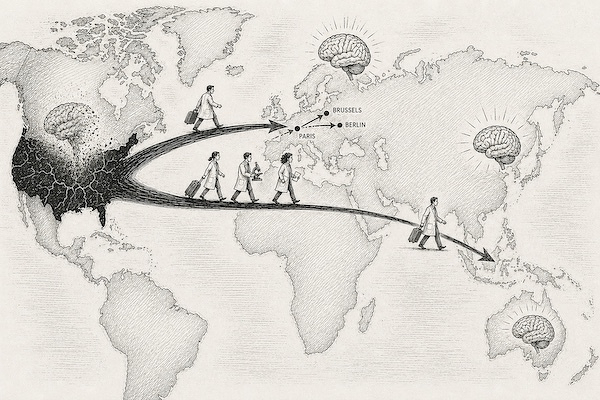
A survey by the journal Nature found that 75% of American scientists were considering leaving the United States. Not thinking about it idly. Actively considering it. Applications from US-based researchers to the European Research Council for early-career grants nearly tripled in two years, from 60 in 2024 to 169 in 2026. Applications for senior researcher grants rose from 23 to 114 in the same period.
Europe is not being passive about this. The European Commission pledged 500 million to lure international researchers, with a program explicitly named “Choose Europe.” France’s Aix-Marseille University launched a “Safe Place for Science” program and received nearly 300 applications from Americans almost immediately. Belgium’s Vrije Universiteit Brussel set up a dedicated contact point for US researchers seeking refuge. The Netherlands, Germany and the UK are all running competing initiatives.
Aix-Marseille put it plainly: “Europe saw many scientists flee for the US during World War II. It now appears that experts are starting to flow in the opposite direction.”
Canada announced a C$1.7 billion talent scheme. Australia is already seeing results, with academics from Harvard, Dartmouth and Cornell departing for Australian universities. And then there is China, which pledged a billion-dollar spending boost for science and is not subtle about its interest in disgruntled American researchers.
The displaced expertise is not disappearing. It is being redistributed. The only question is who benefits from it.
The damage is not reversible on demand
The Trump administration appears to believe that science can be turned on and off like a tap. Cut the funding, fire the board, cancel the grants, then restore it all later if needed. This is not how research ecosystems work.
A laboratory takes years to build. A research team, once scattered, does not reassemble. A pipeline of PhD students and post-docs, once diverted to other countries and other careers, does not simply flow back because the political climate eventually changes. The damage compounds quietly, and it shows up a decade later in the statistics, when the next generation of medical breakthroughs, materials science advances and computing innovations emerge predominantly from European and Asian institutions, not American ones.
“We’ve lost a generation of scientists,” was how one analyst described the situation to The Pie in March 2026. That is not hyperbole. That is the realistic assessment of people who study research pipelines for a living.
For decades, the US attracted the world’s best scientific minds. Researchers from Europe, Asia, Australia and everywhere else went to America because that is where the funding was, where the equipment was, where careers were made. Trump’s policies are dismantling that gravitational pull with startling speed. And the pull, once lost, is extraordinarily hard to rebuild.
What this means for everyone else
Watching from Melbourne, the picture is clarifying quickly.
Australia, Europe, Canada, South Korea, Japan and yes, China, are all beneficiaries of a policy setting in Washington that amounts to self-harm at civilisational scale. The scientists being pushed out are not low performers. They are the researchers who attracted competitive grants, ran active laboratories, and produced the papers that kept American universities at the top of global rankings.
The post-war analogy is apt but incomplete. Operation Paperclip was a deliberate, strategic effort to harvest talent. What the rest of the world is doing now requires no strategy at all. America is doing the harvesting for them.
History will record this period as the moment the United States decided that scientific independence was a threat rather than an asset, and acted accordingly. The scientists now choosing Brussels over Boston, Paris over Princeton, and Melbourne over MIT are not being disloyal. They are making rational decisions in response to irrational policy.
The irony is almost too large to hold. A country that once reached the moon by importing the intellectual capital of a defeated enemy is now exporting its own to the rest of the world, one boilerplate termination email at a time.
Sources:
- Trump fires NSF’s oversight board science.org
- US brain drain: the scientists seeking jobs abroad nature.com
- Research cuts fuel scientific brain drain statnews.com