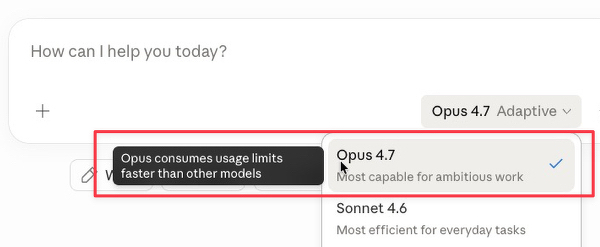
I switched my default to Opus 4.7 the day it shipped. A few days later I hit my rolling 5-hour usage limit on claude.ai. Then I hit it again. By the third lockout in one day I was puzzled.
Hmm. This hadn’t happened before.
I’d been running Opus 4.7 as the default for everything. Code, writing, casual queries, illuminated business plans. Anything that needed a model, it got the newest, shiniest one.
Turns out the new shiny one is hungry. Very hungry.
The headline price is misleading
If you’re on a Pro or Max plan you don’t see per-token costs, just message limits and lockout screens. The Anthropic API publishes per-million-token rates publicly, so that’s the cleanest place to see what’s actually eating the budget.
Opus 4.7 lists at US$5 per million input tokens and US$25 per million output. Same as Opus 4.6. Anthropic bills in your local currency at the spot rate, but the published numbers are US dollars and that’s how everyone quotes them.
What they didn’t keep flat is the tokenizer. Opus 4.7 uses a new tokenizer that consumes up to 35% more tokens for the same chunk of text. The headline rate didn’t move. The effective rate did, to roughly US$6.75 input and US$33.75 output per million tokens for text-heavy work.
For a routine coding session (1,000 input tokens, 500 output, run a thousand times) Opus 4.7 costs about US$17.50 at list. The same workload on Sonnet 4.6 costs US$10.50. On Haiku 4.5, US$5.
That’s 3.5 times Haiku for Opus 4.7 at list. Closer to 4.7 times once tokenizer inflation kicks in. And because output tokens cost five times more per token than input, any verbosity in the response gets amplified.
It’s not just you
The lockouts aren’t only about your usage. Anthropic is under enormous pressure right now. Demand has surged and they’re juggling gargantuan server loads. That’s why they recently cut off OpenClaw access to flat-rate monthly plans. Heavy automated Opus usage on a flat fee was unsustainable economics for them, and the cap exists to keep the lights on for everyone else.
The pain is the same on either side of the billing model. Opus 4.7 eats more for marginally better output. API users see it on the invoice. Monthly plan users see it in the lockout screen.
The capability gap is smaller than the price gap
Here’s the part that hurts. On SWE-bench, the standard real-world coding benchmark, the scores cluster tightly.
Opus 4.6 sits at 80.8%. Sonnet 4.6 at 79.6%. Haiku 4.5 at 73.3%.
The gap between Opus and Sonnet is 1.2 percentage points. The gap between their per-token cost is 40%. For compiled languages the compiler is your ground truth anyway, so that 1.2% basically disappears in practice.
I was burning through token windows for a benchmark difference rounding to noise.
When Opus actually earns it
Opus is right when the task is genuinely hard. Multi-file refactors across a large codebase. Cross-system reasoning where the model needs to hold a lot of context. Long-form synthesis where instruction-following matters and one hallucinated detail breaks the deliverable. Board papers. Strategic memos. Agentic loops where tool-calling accuracy matters and the whole chain crashes if a parameter is wrong.
Sonnet 4.6 is right for almost everything else. Building features. Writing prose. Summarising. Quick analysis. None of it needs Opus.
Haiku 4.5 has its own niche. Boilerplate. Test scaffolding. High-volume pipelines where you’re processing thousands of items and the bill compounds (Felix uses Haiku for exactly this reason).
The effort dial is a second cost lever
There’s another knob most people miss. Opus 4.7 in claude.ai now exposes effort levels (low, medium, high, max). High is the default. Max can spend 10 times more tokens than low on the same prompt because adaptive thinking expands the reasoning budget proportionally.
For routine queries, medium is fine. High is generous. Max is genuinely wasteful unless you’re doing something that benefits from extended reasoning.
What I changed
Sonnet 4.6 is now my default for 90%-plus of what I do. Opus 4.7 is reserved for the genuinely hard stuff where I’d actually notice the difference. Haiku handles bulk grunt tasks like web lookups and summarisation.
Using Opus 4.7 all day, every day is like driving a Ferrari to the milk bar. Powerful, expensive, complete overkill.
Sonnet 4.6 is very capable and much less hungry. Learn from my experience and lock it in as your default. More is not always better.
Sources
- Anthropic pricing documentation (platform.claude.com)
- Finout: Claude Opus 4.7 pricing, the real cost story (finout.io)
- Artificial Analysis: Sonnet 4.6 everything you need to know (artificialanalysis.ai)
- Anthropic effort levels documentation (platform.claude.com)
- Anthropic adaptive thinking documentation (platform.claude.com)
- VentureBeat: Anthropic cuts off Claude subscriptions for OpenClaw (venturebeat.com)