AI has made me more tired than I’ve ever been in my career.
Not from overwork in the traditional sense. The hours are fine. The problem is the pace. I can iterate on an iOS app three times faster than I can actually test it. Claude ships a new build; I’m still tapping through the previous one. The work is compressing into a loop of generate, review, generate, review and the reviews are the bottleneck. My brain is the bottleneck.
A 20-minute coffee nap most afternoons has made a measurable difference. And the reason it works is genuinely interesting.
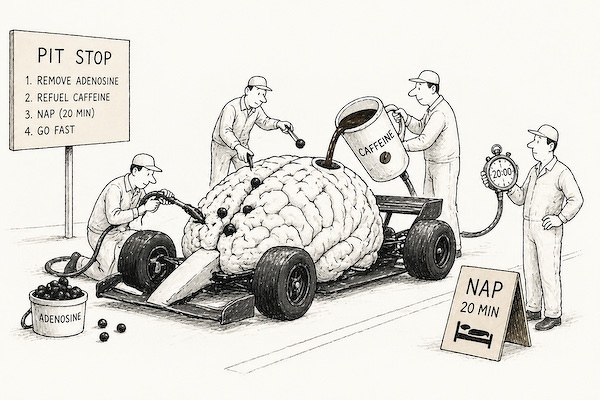
The chemistry is the point
When your brain does work, it produces adenosine as a byproduct. Adenosine accumulates across the day, binding to receptors that progressively signal fatigue. The longer you go, the more receptors are occupied, the harder thinking becomes. This is not metaphorical tiredness. It is a literal chemical load.
Caffeine works by blocking adenosine receptors. It doesn’t reduce the adenosine itself, it just temporarily stops it docking. That’s why coffee wears off and you crash — the adenosine was waiting the whole time.
Here’s where the coffee nap gets clever. Caffeine takes roughly 20 to 30 minutes to absorb into the bloodstream after you drink it. That window is exactly long enough for a short nap to clear adenosine from your receptors naturally. When you wake, caffeine arrives to block receptors that are already partly vacant. You’re not fighting the accumulated load. You’re hitting a reset state with a boost on top.
It’s additive in a way that neither intervention is alone.
The research is solid
This isn’t biohacker folklore. A 1997 study published in Psychophysiology by Loughborough University researchers found that participants who had a coffee nap before a driving simulator made significantly fewer errors than those who napped only or drank coffee only. The effect was replicated in Japan by Hayashi and colleagues, who confirmed improvements on cognitive performance tests specific to the combined intervention.
NASA research on pilot alertness has long supported the power nap as a recovery tool. The coffee nap layers a pharmacological mechanism on top of that baseline finding.
How to do it (Melbourne edition)
Here’s good news if you’re drinking real coffee. A double-shot flat white carries around 130 to 150mg of caffeine. A long black is in the same range. A single-origin pour-over from a serious roaster will land somewhere between 80 and 120mg depending on the bean and brew ratio. All of these are in the effective window. The research threshold is roughly 100mg — enough to meaningfully block adenosine receptors once it arrives.
Drink it quickly. Don’t sip it across 20 minutes — that defeats the timing entirely. Then lie down immediately and set an alarm for 20 minutes.
Most people don’t fall into deep sleep that fast. You’re aiming for a light doze, or even just the relaxation of horizontal stillness with eyes closed. That’s enough. Do not sleep longer than 25 minutes or you’ll enter slow-wave sleep and wake up with worse cognition than you started with. That groggy, heavy-headed feeling has a name: sleep inertia. The 20-minute window is specifically designed to avoid it.
Wake up, give yourself two or three minutes for the caffeine to finish crossing the blood-brain barrier, and get back to work.
Early-to-mid afternoon is the ideal window, roughly 1pm to 3pm, aligned with the natural post-lunch dip in circadian alertness. Any later and you risk disrupting your ability to fall asleep at night.
A note on what counts as coffee
The original research used instant coffee dissolved in warm water — a concession to laboratory conditions, not a recommendation. Filter drip, the American default, typically delivers 95 to 180mg per cup depending on brew strength. It works. But the caffeine profile is flatter and slower to absorb than espresso, which concentrates the dose.
Starbucks, for what it’s worth, will give you calories and sugar before it gives you alertness. Australians figured this out faster than most. When Starbucks launched in Australia in 2000 and expanded aggressively to 84 stores, they assumed the formula that conquered America and Europe would work here too. By 2008 they had closed 61 of those stores — 73% of the network — in the most humiliating retreat in their global expansion history. The reason was simple: Australians had been drinking properly extracted Italian-style espresso since the postwar wave of European immigration. A milky, over-sweetened cup of something vaguely coffee-flavoured wasn’t a treat. It was a disappointment.
Melbourne in particular treats coffee as a serious discipline. The city that gave the world the flat white (yes, this is contested, no, we don’t care) has a cafe culture built on high-extraction espresso, skilled baristas and beans sourced with the same attention a sommelier brings to wine. The caffeine dose in a Melbourne flat white is exactly what you need for a coffee nap, delivered in a format you’d actually want to drink.
The AI context matters
AI doesn’t just accelerate output, it accelerates the demand on your attention — and that second part is the thing most people miss. Every hour you use it well, you produce work that would have taken four hours before. The review and QA load scales with that.
A deteriorating brain at 3pm is a worse bottleneck than a slow model. The cognitive cost of a missed bug in UAT, a bad editorial call, or a lazy architecture decision because you were too tired to interrogate it properly is measurable.
Twenty minutes horizontal and one good flat white is cheap insurance against that.
The science is there. The protocol is simple. In Melbourne, at least, the raw material is never far away.
Sources:
- Coffee Nap — Sleep Foundation
- Hayashi, M. et al. (2003). The alerting effects of caffeine, bright light and face washing after a short daytime nap. Clinical Neurophysiology
- Reyner, L.A. & Horne, J.A. (1997). Suppression of sleepiness in drivers: combination of caffeine with a short nap. Psychophysiology