Two thirds of the weight comes back within a year of stopping Ozempic. I keep thinking about that number. And I keep coming back to a diet book published in 1991 that understood exactly why.
The book is called The Hacker’s Diet. It was written by John Walker - co-founder of Autodesk and the original programmer behind AutoCAD. By his late thirties Walker had tried everything. Nothing worked. So he did what engineers do: he stripped the problem back to first principles, built a measurement system and ran the experiment on himself.
He went from 97.5 kilograms to 65.8 kilograms in under a year.
I found it around 2009 and it took me to the lightest I had been since my teens. It is still the most sensible thing written on the subject. And it costs nothing - Walker has made it permanently and freely available at fourmilab.ch/hackdiet since he published it thirty-five years ago.
Why Ozempic doesn’t solve the problem
Semaglutide drugs - Ozempic for type 2 diabetes management, Wegovy for weight loss - suppress appetite through GLP-1 receptor activity. They work. People lose significant weight while taking them.
Then they stop. The STEP 1 extension trial, published in 2022, tracked participants for a year after they discontinued semaglutide. They had lost 17.3% of their body weight on the drug. A year after stopping, they had regained two thirds of it.
This is not a criticism of the drugs themselves - for people with serious metabolic conditions they are genuinely valuable. But the suggestion that a weekly injection has made weight management a solved problem doesn’t survive contact with that data. The weight comes back because the underlying behaviours haven’t changed. The drug was doing the work. When it stops, the body returns to what it knows.
Walker understood this in 1987. He called it the rubber bag model: your body is a container. Energy flows in through food and out through metabolism and activity. The numbers either balance or they don’t. There is no pharmaceutical shortcut to permanently changing that equation - there is only changing what you eat and how much you move.
The Hacker’s Diet is the anti-fad diet because it doesn’t pretend otherwise.
The insight that changes everything
The most useful idea in the book is deceptively simple: your daily weight reading is almost meaningless.
Step on a scale two mornings in a row and the reading can shift a kilogram in either direction. Not because you gained or lost fat overnight - but because of water retention, food in transit, the glass of wine at dinner, the slightly different time you woke up. Daily weight is noise. Reacting to it is like trying to navigate by a compass held next to a magnet.
Walker’s solution is a simple exponential moving average:
Trend(today) = 0.9 × Trend(yesterday) + 0.1 × Weight(today)
You record your weight every morning. The formula does the rest. The trend line filters out the noise and shows you the underlying signal. Ignore the blue lines. Watch the red.
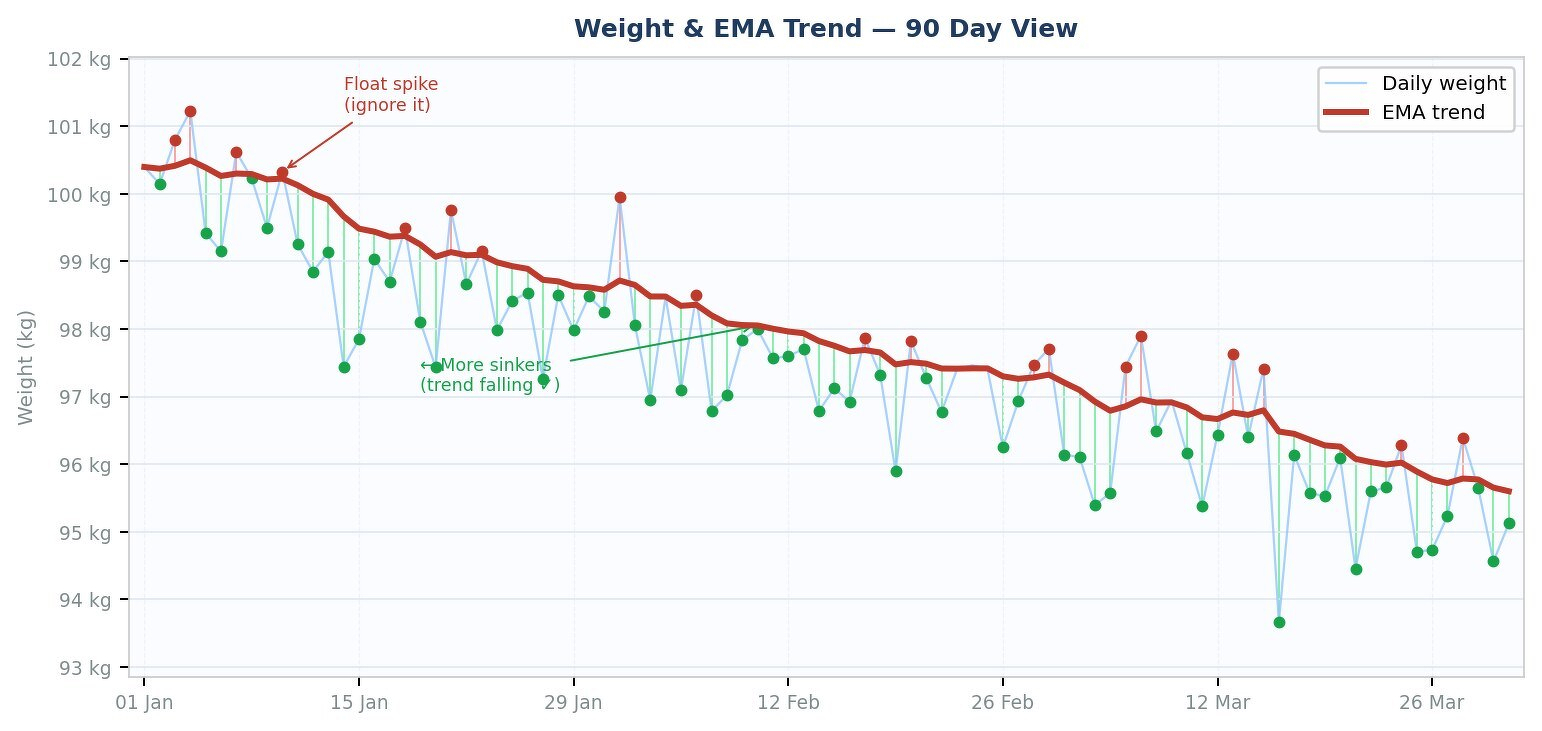
Walker called readings above the trend line floats and readings below it sinkers. Consistent sinkers over two to four weeks means the trend is falling and fat is being lost - regardless of what the daily number is doing. Consistent floats means the trend is rising. That is literally all you need to know.
This reframe alone is worth more than most diet books. Stop judging progress by today’s number. Judge it by the direction of the line over weeks. It sounds obvious stated plainly. It is not how most people approach the problem.
Why it has lasted thirty-five years
Most diet books have a shelf life of about three years. They propose a mechanism - cut carbs, eat in a window, follow a colour chart - ride a wave of enthusiasm, then fade when people find the mechanism is either too hard to sustain or not as effective as advertised.
Walker’s book has no mechanism to go stale. The rubber bag is a physical law. The exponential moving average is a mathematical filter. Human bodies have not updated their firmware since 1991.
The book’s only dated element is its stubborn refusal to use metric - Walker is thoroughly, unapologetically imperial throughout. That is a conversion table problem, not a conceptual one.
It is also, for a certain kind of reader, deeply satisfying. The method is presented not as a lifestyle or a philosophy but as a feedback and control system. You are the engineer. The scale is your sensor. The trend is your signal. You adjust based on data, not on how you feel about what you ate on Tuesday. If you are the sort of person who defaults to a spreadsheet over a fad, this is the diet for you.
A word about Walker’s generosity
Walker could have commercialised this. The method works, the book is well-written and the intellectual property was entirely his. Instead he put it on the internet and left it there. For free. For everyone. For thirty-five years.
In an era of $300 twelve-week programs and subscription apps that charge you to log your own body weight, that kind of quiet generosity deserves acknowledgement.
The full book is at fourmilab.ch/hackdiet. Read it. There is nothing to buy.
Part 2 will cover the practical setup
Update: I should have checked. Alas, John Walker passed away in Feb, 2024. Wikipedia. His works and ideas live on. Someone is keeping his web server online. For how long?
Sources