You have seen the move a thousand times. Someone lays out clear, well-researched evidence and the reply comes back: “that’s just your opinion.” Vaccine safety, climate data, the economics of a trade decision - the subject barely matters. The move puts a measured finding and a gut feeling on the same shelf, equally weighted, free to be picked up or put down depending on which one feels better that morning.
It looks like a debating trick. It is actually a worldview. And Brexit is the cleanest proof we have of what that worldview costs, because unlike most arguments about science and reason, this one came with a bill you can add up.
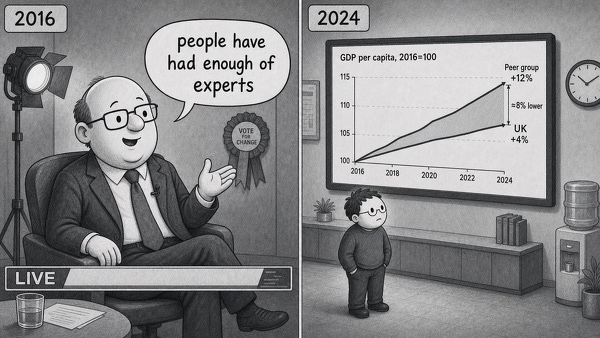
Almost ten years ago, a senior British minister looked down the barrel of a television camera and made the move official. Michael Gove, three weeks before the referendum, talking to Sky News' Faisal Islam, who had just run through the economists, institutions and allies warning that leaving the European Union would make Britain poorer.
Reading this in a feed reader? Watch the clip on YouTube.
“I think the people of this country have had enough of experts,” he said. He went on - the full sentence was about experts “from organisations with acronyms” getting things wrong - but the qualifier never mattered. The clip was the clip. A nation was told that careful forecasting and a hopeful feeling deserved the same hearing, and a narrow majority agreed.
A decade on, the experts have their answer. It is more uncomfortable than either side wants to admit.
The immediate predictions were wrong. There was no emergency recession in the months after the vote. The Treasury’s scariest short-term scenarios did not arrive, and Leave campaigners have spent ten years pointing at that empty space. They are not wrong to.
But the immediate forecast was never the one that mattered. The serious claim was that Britain would be permanently poorer outside the EU, and that claim has held up with depressing precision.
You can see it in a single picture. Take UK GDP per head and lay it next to an average of 33 comparable advanced economies. The two track each other almost perfectly until mid-2016, then split at the referendum and never rejoin. The gap that opens up is the no-Brexit Britain that did not happen.
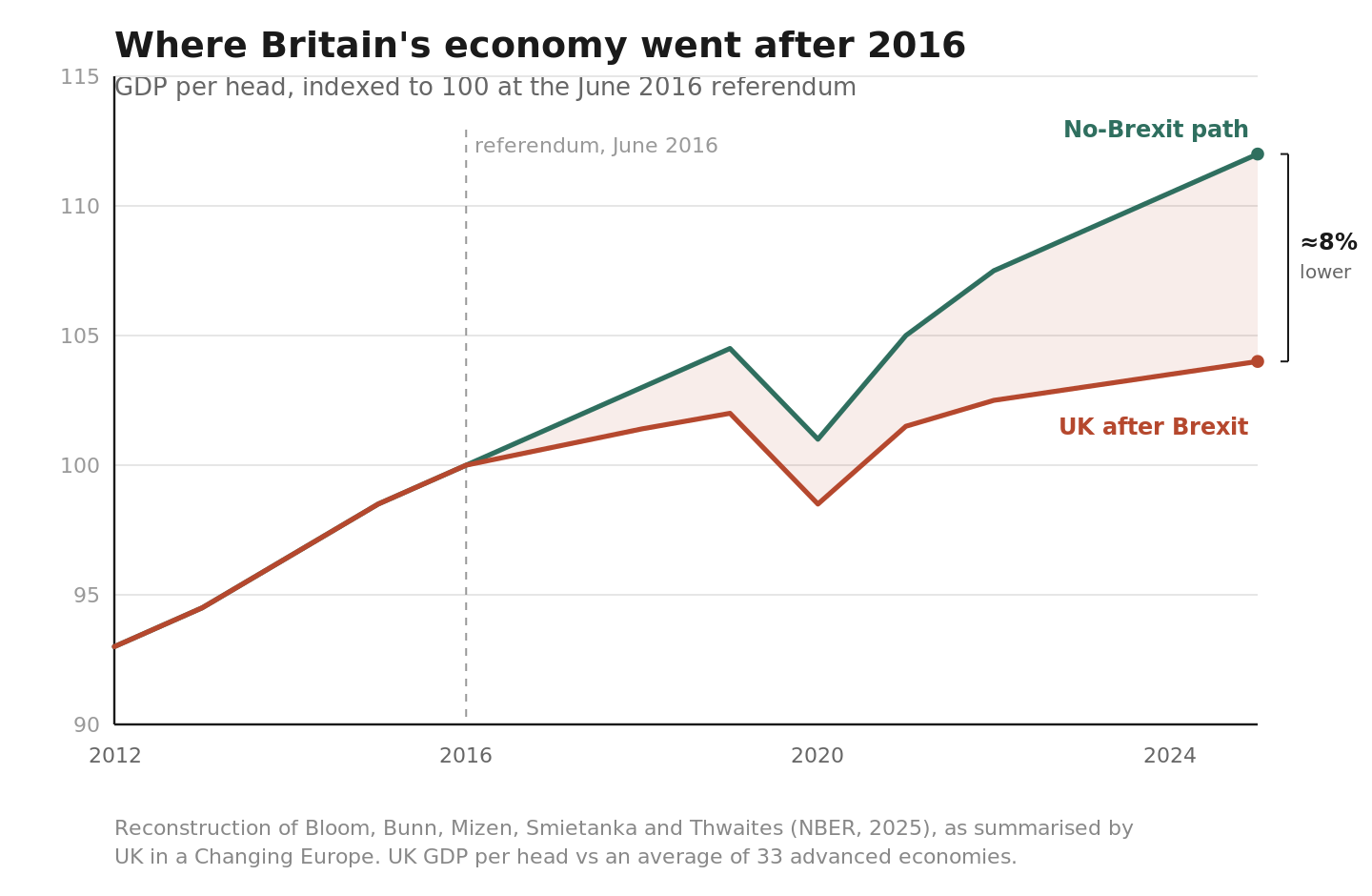
That is the work of Nicholas Bloom and colleagues, published through the National Bureau of Economic Research in late 2025. Their headline: by 2025, UK GDP per head was 6 to 8% lower than it would have been without Brexit, with the central estimate around 8%. What makes it hard to dismiss is the cross-check. They rebuilt the comparison five different ways and then tested it against survey data from thousands of individual UK firms, and the top-down and bottom-up numbers landed in the same place.
Start with the most conservative source. The Office for Budget Responsibility, the government’s own independent forecaster and not a Remain campaign outfit, assumes Brexit knocks 4% off Britain’s long-run productivity, with UK imports and exports both settling around 15% lower than they would have been inside the single market. That is the official number.
Independent estimates run higher. John Springford at the Centre for European Reform builds a statistical “doppelganger” Britain - a weighted basket of comparable economies that tracked the UK closely before 2016 - then measures the gap that opens after the vote. His read: GDP around 5.5% lower, business investment around 11% lower, goods trade around 7% lower.
The chart above sits at the upper end of that range, around 8%, or somewhere between £180 billion and £240 billion over the decade. Goldman Sachs has landed near the same mark. The National Institute puts it at 5 to 6%.
Pick whichever figure you find most credible. They scatter, but they all point the same way, and none of them point at zero. This is what the evidence looked like all along. The experts who predicted an overnight crash were wrong. The experts who predicted a slow, grinding, permanent loss were right. “Enough of experts” flattened those two very different forecasts into one dismissal, and a flattened distinction is exactly what a slow-burn cost needs in order to survive. Nobody riots over a recession that never happens. Everybody shrugs at a few percent of GDP that quietly never arrives.
There is one more thread worth pulling, because the case for Brexit was never purely domestic. In 2020 Britain’s own Intelligence and Security Committee published its long-delayed report on Russia and found that the government had not sought to investigate whether Russia interfered in the 2016 vote. The committee’s charge was not that interference was proven. It was that the question was effectively avoided. A country told to stop trusting experts also chose not to ask who else might have had a hand on the scale.
So here is the point, and it reaches a long way past Brexit. Treating settled evidence as one opinion among many is not open-mindedness. It is not healthy scepticism, and it is not standing up to elites. It is a method for choosing what feels good over what is true, and the method does not care which subject you point it at. Point it at climate science and the cost lands on the next generation. Point it at public health and it lands on the immunocompromised kid in the next classroom. Point it at trade economics and it lands, with a ten-year delay, as several percent of national income that simply never shows up.
That is the receipt Britain is holding. The expert verdict, delivered late and paid in full. The lesson travels right across the globe, and it is not subtle: when reason and evidence get waved away because the alternative feels better, the bill still comes. It just comes for all of us, and often for the people who never got a vote in their future.
Sources:
- How the UK economy has changed since the Brexit vote, in charts (theguardian.com)
- EU: In or Out? Faisal Islam interview with Michael Gove (skygroup.sky)
- Brexit analysis (obr.uk)
- Cost of Brexit (cer.eu)
- Brexit’s impact on the UK economy (Bloom et al., NBER 2025) (ukandeu.ac.uk)
- Brexit hit to UK economy double official estimate, study finds (bloomberg.com)
- Intelligence and Security Committee Russia report (en.wikipedia.org)