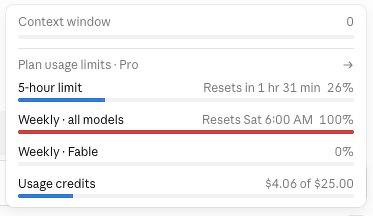
The five-hour meter is still at 26 per cent. The weekly all-models meter is at 100.
It is Thursday morning and I have just blown through my Claude Cowork weekly quota. It resets on Saturday at 6:00 a.m., so I have two days to contemplate the limit of my enthusiasm for agentic AI.
Fortunately, this is not the hard stop it once might have been. Claude simply moves to usage credits. There is no ceremony, no downgrade and no interruption to the work. I have US$25 sitting there and, as the screenshot shows, have spent US$4.06 of it already.
I will stretch it as far as I can with the lowest cost models. I should probably stop studying every dollar and cent as it disappears. I am almost certainly still well ahead of taking out a Max plan.
The missing middle
This is where Anthropic’s pricing gets awkward for someone like me. Claude Pro is US$20 a month. Claude Max starts at US$100 a month. There is a US$80 gap between the plan that I can demonstrably outgrow and the plan that still feels like more capacity than I need every month.
My needs are beyond the former but not sufficient to justify the latter. At least not yet.
Usage credits are a surprisingly sensible answer. They cover the heavy week without asking me to make a permanent US$100-a-month decision. The switch is seamless enough that it feels less like punishment for using the thing and more like a flexible extension of the subscription. I recall there was a time when the usage credits only switched on when hitting 5-hour limit, not weekly limit. I think Anthropic have made the change as they’ve brought Fable 5 on to a credits only basis.
My recommendation is to enable usage credits and add a small balance before you hit a limit. It turns a hard stop into a decision you have already made. Anthropic also lets you set a monthly spending cap, so you can keep working without handing over control of the budget.
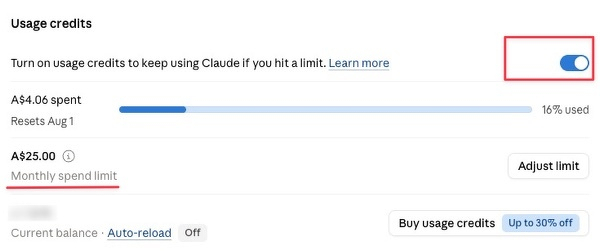
I am not delighted to be spending more money on top of the US$20 Pro plan. But, for the way I work, pay as you go is better value than US$100 a month for Max. If I were doing repeated, heavy rounds of vibe-coding, Max would make more sense. I am not there yet.
Of course, that depends on keeping an eye on the arithmetic without becoming obsessed by it. The cost of a few days of extra work is not the story. The useful work is the story.
My only real grumble is visibility. I wish Anthropic made credit use easier to see in real time. The information is there, but getting a clear picture of what is being consumed still involves clicking through too many screens.
What those credits are buying
The credits are not a second subscription tier. Anthropic bills them at its standard API rates, separately from the Pro plan. That means input and output tokens both matter. So does the model.
This is where it gets more interesting than a simple US$20 versus US$100 comparison. The nominal rates do not always tell you what the work will cost.
| Model | Nominal input / output rate | Tokenisation position |
|---|---|---|
| Sonnet 4.6 | US$3 / US$15 per million tokens | Pre-change baseline |
| Opus 4.6 | US$5 / US$25 per million tokens | Pre-change baseline |
| Opus 4.7 | US$5 / US$25 per million tokens | Updated tokenizer, roughly 1.0 to 1.35 times more tokens for the same input |
| Opus 4.8 | US$5 / US$25 per million tokens | Current nominal rate; I have not found a comparable public token-count multiplier |
| Sonnet 5 | US$2 / US$10 introductory, then US$3 / US$15 | Updated tokenizer, roughly 1.0 to 1.35 times more tokens for the same input |
Now that I am onto extra usage credits, I will run with Sonnet 5. It uses more tokens than 4.6, but it is still cheaper at the current introductory price until 31 August.
The change began with Opus 4.7. Anthropic kept its US$5 and US$25 per-million-token rates from Opus 4.6, but changed the tokenizer. In its own description the same input can become 1.0 to 1.35 times as many tokens. Simon Willison’s comparison measured 1.46 times as many tokens for an Opus system prompt. Same nominal price, more metered units. His reasonable estimate was about 40 per cent more expensive for that kind of prompt.
Sonnet 5 uses the same basic approach. At the launch rate of US$2 input and US$10 output per million tokens, even a 1.35 times token increase works out at US$2.70 and US$13.50. That is still below Sonnet 4.6’s US$3 and US$15. Anthropic says the introductory price is designed to make the move roughly cost-neutral.
After 31 August, though, Sonnet 5 returns to US$3 and US$15. If the token count lands at the top of Anthropic’s published range, the effective rate becomes US$4.05 for input and US$20.25 for output compared with Sonnet 4.6. That is the inflation worth watching.
This is not an argument against newer models. Better agentic work may easily justify more tokens, especially for heavy vibe-coding where Max becomes the more rational plan. It is an argument for looking past the headline rate. When credits are metered in tokens, a tokenizer change is a price change wearing a technical hat.
GPT is the second lane
My other strategy is to keep a separate US$20-a-month GPT subscription. It has generally felt more generous with its limits and, in the past, I have seemed to get further for my dollars with it.
That is increasingly easy to do because the GPT-5.6 generation has narrowed the gap. I have ported my skills from Claude Cowork to GPT Work and, for the work I throw at both of them, they now feel interchangeably equal. It is hard to tell the difference in the finished work. (Note: Skills are an open standard format for guiding agents to complete more complex tasks).
There was a time when Claude’s writing was clearly better. It was more natural, more human and less inclined to sound as though it had swallowed a consultancy report. GPT-5.6 has closed that gap.
I am still more comfortable with Claude. I trust it more. That is not a benchmark result. It is accumulated experience.
Claude Cowork has been around for many more months and it has earned that trust. I am not yet comfortable giving GPT the more complex jobs that touch my system. I have read enough reports of it going rogue in a few instances to want this generation to have a few more weeks in the field before I relax.
Anyway, the sensible response is not to make this a tribal choice. It is to use both.
Keeping track of the work
The real difficulty with two capable assistants is remembering where the work happened.
I have engineered my session tracker so that I can start a session in Claude Cowork or GPT Work and track it accordingly. That gives me a better account of what I have done, where I have done it and which tool was involved. It is a small thing until you have worked across both platforms for a few weeks and start wondering where a useful piece of thinking lives.
Both can read my Obsidian vault and draw on it for projects and particular topics. That shared context matters. Neither starts cold, and moving a task from one to the other no longer means explaining my world from the beginning.
The current arrangement suits me. Claude is the trusted default. GPT is the capable second lane. Credits are the quiet bridge over a quota wall.
For anyone doing serious work with these tools, the lesson is not to pick a winner too early. Build enough portability into your skills and your context that the work can keep moving when one meter turns red.
Sources
- Claude plans and pricing - https://claude.com/pricing
- Managing usage credits for paid Claude plans - https://support.claude.com/en/articles/12429409-manage-usage-credits-for-paid-claude-plans
- Introducing Claude Sonnet 5 - https://www.anthropic.com/news/claude-sonnet-5
- Claude Token Counter, now with model comparisons - https://simonwillison.net/2026/Apr/20/claude-token-counts/
- ChatGPT Plus - https://help.openai.com/en/articles/6950777-what-is-chatgpt-plus