There are films that are big because of their budgets, their casts or their marketing. Christopher Nolan’s The Odyssey is big in the more literal sense.
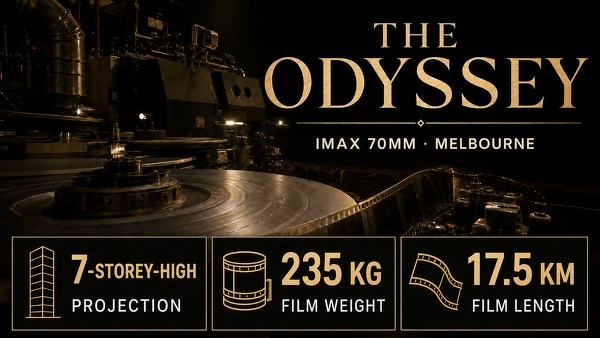
At IMAX Melbourne, the 70mm print weighs about 235 kilograms and stretches about 17.5 kilometres. That is nearly a quarter of a tonne of film, travelling through a projector at roughly a kilometre for every ten minutes of running time. For a 172-minute film, it is a physical object on a scale that most of us have never seen attached to a movie ticket.
And Melbourne is the only place in the Southern Hemisphere where that particular object can be projected.
A very large reason to see it in Melbourne
Nolan shot The Odyssey entirely with IMAX film cameras. In an IMAX 70mm screening, every frame is presented at the tall 1.43:1 ratio, filling the full height of the screen. It is not simply a bigger version of the ordinary cinema image; it is a different canvas.
At IMAX Melbourne, that canvas is exceptional: 32 metres wide and 23 metres tall, the world’s largest 1.43:1 cinema screen. A conventional widescreen presentation uses about 13 metres of that height. The full-frame IMAX presentation reaches all 23.
The cinema says this delivers 40 per cent more image than a regular cinema presentation. More importantly, Nolan composed every frame for it. This is not the familiar IMAX trick where a few spectacular sequences open up and the rest of the film returns to a narrower frame. The Odyssey stays open throughout.
That decision was also a constraint on every day of the shoot. An IMAX camera magazine holds only about two-and-a-half to three minutes of film. When the roll ran out, the scene stopped while the magazine was changed; actors in the middle of an intense location scene had to hold their concentration, then return to precisely the same moment. Lupita Nyong’o described the effect as making everyone exceptionally alert: with so little film available at a time, every department had to be ready before the camera ran.
The cameras created a second problem. Their mechanism is famously loud—too loud for intimate dialogue scenes in earlier Nolan films. For The Odyssey, IMAX and Nolan’s team developed a sound-deadening housing, nicknamed the blimp, to surround the camera and tame that noise enough to record usable dialogue. The solution made the rig even more formidable, but it is what allowed this to become a whole feature shot on IMAX rather than a collection of spectacular inserts.
The format that nearly disappeared
The old 15/70 IMAX system is wonderfully, impractically mechanical. Its 70mm film runs horizontally through the projector, with 15 perforations for each frame. The frame is more than three times larger than standard 70mm. IMAX Melbourne says the format can resolve up to 16K, though the point is less a number than the unusual combination of detail, image area and screen-filling height.
That system was heading for storage. IMAX Melbourne removed its film projection system in 2015, then thankfully retained it rather than disposing of it. Nolan’s Dunkirk brought it back in 2017. His commitment to the format has since made the theatre one of the rare places where its enormous film prints still make practical sense.
The projectionist interviewed by PetaPixel puts it well: film has an idiosyncratic, softer and warmer quality that digital projection does not quite reproduce. A faint mark, a speck of dust, the texture of the image—these are not necessarily defects to be engineered away. They are part of the medium. The useful comparison is CD versus vinyl: the same song, but a different physical character.
The numbers behind the spectacle
| The Odyssey at IMAX Melbourne | Scale |
|---|---|
| Running time | 172 minutes |
| IMAX 70mm print length | About 17.5 km |
| IMAX 70mm print weight | About 235 kg |
| Film consumed | Roughly 1 km per 10 minutes |
| Screen size | 32 m × 23 m |
| Full-frame aspect ratio | 1.43:1 |
| Image area versus regular cinemas | 40% more |
| Southern Hemisphere IMAX 70mm prints of The Odyssey | One: Melbourne |
The Odyssey opens at IMAX Melbourne on 16 July. If ever there were a film for which the cumbersome, beautiful version is the point, this looks like it.
Sources
- This Is What It’s Like Projecting Gigantic 70mm IMAX Film for The Odyssey — PetaPixel, including the projectionist interview and print-scale figures
- The Odyssey — IMAX 70mm film presentation — IMAX Melbourne, runtime, format and booking information
- The IMAX difference — IMAX Melbourne, screen dimensions and 70mm format overview
- IMAX 70mm film — IMAX Melbourne, aspect ratio, presentation and film-format detail
- A look inside Christopher Nolan’s The Odyssey by the numbers — Associated Press, camera magazine duration and the sound-reducing “blimp”