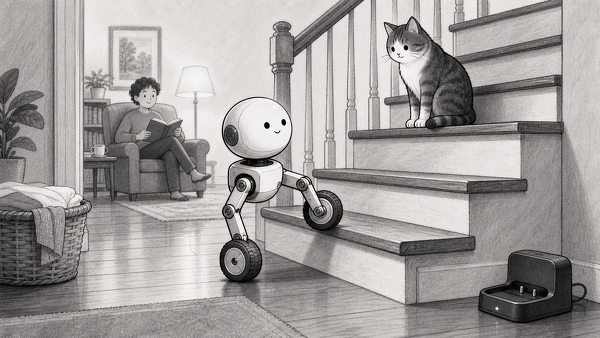
A domestic AI companion does not need to walk everywhere. It just needs a plan for the stairs.
A house is mostly a collection of flat surfaces joined by one deeply inconvenient invention: the staircase.
That is the obvious problem with giving an AI companion wheels. Wheels are wonderfully efficient until the floor suddenly rises by 18 centimetres. Then they become a firm commitment to remaining downstairs.
The obvious response is to give the robot legs. Humans manage stairs with two of them and robot dogs can climb remarkably well.
But walking is an expensive way to cross a kitchen floor.
On the same day I wrote the original post, Mia Silverio at Prof G Media published Why Tech Is Irrationally Obsessed With Humanoid Robots. Her argument is that the fascination with humanoid robots has less to do with rational engineering than the science-fiction dream of a mechanical servant shaped like us.
That is exactly the trap.
We do not need a robot shaped like a person. We need a robot shaped for the job.
A Ponzi scheme of hope
The forecasts for humanoid robots have moved beyond optimism. They are becoming unhinged.
The usual hype merchants are no longer forecasting a market. They are declaring a destiny.
Silverio collects some beauties. Nvidia CEO Jensen Huang was asked when humanoid robots would reach human-level ability. His answer:
“This year.” - Jensen Huang, asked when robots would reach human-level capabilities, CES 2026. Sky News, 7 January 2026
Huang has also described humanoid robotics as potentially one of the largest industries ever.
“We now know how to build these things, train these things, and operate these things.” - Jensen Huang, NVIDIA GTC Paris keynote. NVIDIA, 11 June 2025
Elon Musk has gone further. By his reckoning, Tesla’s cars are becoming a sideshow to a robot that is not yet doing meaningful work at scale.
“~80% of Tesla’s value will be Optimus.” - Elon Musk, X. Reported by CNBC, 1 September 2025
Morgan Stanley forecasts nearly one billion humanoid robots by 2050 and a market worth US$5 trillion. Prof G Media calculates that reaching one billion machines would require annual growth of 69% for 25 years. Even smartphones managed peak adoption growth of only 30% to 40% a year for nine years.
The promises feed each other. A chief executive makes an extraordinary claim. An investment bank turns it into a market forecast. The forecast supports more investment and a higher valuation. That investment is then cited as proof the original claim was right.
It is not a Ponzi scheme in the legal sense. It is a Ponzi scheme of hope. Each layer depends on the next prediction being larger than the last while the useful, affordable product remains a few years over the horizon.
Useful humanoid robots may eventually arrive. But good engineering starts with the job that needs doing, not the valuation story built around it.
Wheels win on flat ground
Wheels are quiet, mechanically simple and efficient. Once rolling, they do not need to be lifted and repositioned with every step.
A walking robot must continually move its limbs, coordinate several powered joints and maintain its balance. That is an impressive engineering achievement. It is also a great deal of machinery and computation devoted to the basic business of crossing the hallway.
The sensible answer is not wheels or legs. It is wheels almost all the time, with just enough leg for the moments when rolling is not enough.
The most successful robots already follow that principle. Amazon now operates more than one million industrial robots. Prof G Media reports that they save the company an estimated US$4 billion a year and have helped employees handle 22 times as many packages as they did a decade ago.
Those robots do not have heads, arms or legs. Amazon redesigned its warehouses around machines built for a specific purpose. Their failure to resemble people has not held them back.
This is no longer just a sketch on the back of an envelope. At CES 2026, Roborock demonstrated the Saros Rover, a robot vacuum with two independently controlled wheel-legs. It rolls normally across flat floors, then extends and repositions its wheels to climb stairs while keeping its body level. It can even clean each tread on the way.
Reading this in a feed reader? Watch the Saros Rover demonstration on YouTube.
Researchers have taken the same idea further with Ascento, a compact two-wheeled robot with articulated legs. A 2024 research project demonstrated an Ascento robot climbing 15-centimetre stairs. The machine balances on two wheels, rolls efficiently on flat ground and uses its legs when the terrain demands them.
The useful distinction is not wheels versus legs. It is wheels for ordinary movement and legs for discontinuities.
So how much leg does a domestic companion need?
There is no single answer because it depends on how the mechanism moves. Take a stair with a rise of 180 millimetres and a tread 280 millimetres deep. A rigid leg reaching directly from one step to the next faces a diagonal distance of 333 millimetres. Add clearance and a sensible safety margin and a pivot-to-axle length of about 400 millimetres is a reasonable starting point.
A folding linkage like the Saros Rover does not need to span that full diagonal in one movement. It can raise the body, move a wheel forward, transfer the weight and retract. For that design, the critical measurement is closer to 220 to 250 millimetres of usable vertical wheel travel, combined with enough forward movement to place the wheel safely beyond the stair nosing.
The rest is control. Each wheel needs an independent brake so it can become a temporary foot. The robot needs depth sensing to measure the next tread, an inertial sensor to keep its body level, high-grip tyres and a low centre of gravity. It also needs a fail-safe descent mode. Gravity is much less forgiving on the way down.
Two wheel-legs are enough. Humans demonstrate the principle every day. The engineering challenge is making a narrow wheel behave like a stable foot for a few seconds at a time.
AI companion does not need to fold the laundry
Once a machine can move around the house and converse intelligently, it is tempting to keep adding jobs.
Could it collect the washing, load the machine, transfer wet clothes into the dryer, fold everything and put it away?
Possibly. But “do the laundry” is not one additional feature. It is an entire robotics programme.
The machine would need arms, hands or grippers. It would need to recognise and separate fabrics, open different machines, measure detergent, manipulate wet and tangled clothing, find dropped socks and fold objects with almost no fixed shape.
Prof G Media offers a perfect reality check. Weave Robotics has announced a US$8,000 humanoid that can fold laundry, provided the clothes are not inside out and the load contains no sheets or blankets. That is not a criticism of the prototype. It is a demonstration of how quickly an apparently simple household task expands beyond a robot’s operating limits.
The economics are just as awkward. The article puts the current manufacturing cost of a humanoid robot between US$100,000 and US$200,000. It also cites a survey in which 60% of American adults said they were not interested in a robot to assist with household tasks. Of those who were interested, only 30% were prepared to pay more than US$1,000.
It would become taller, heavier and more expensive. It would also become considerably more hazardous around people.
There is nothing wrong with building a robotic housekeeper. It would be enormously valuable, particularly for older people and those with limited mobility. But it is a different product from a companion. Combining both ambitions risks turning a small, affordable presence into a complicated machine that few households can justify.
The intelligence may be ready long before the hands are.
A companion does not need to earn its place by completing chores.
The cat remains in charge
People are perfectly happy having cats for companionship.
A cat does very little around the house. It does not fold laundry, monitor the security cameras or remind you about an appointment. It may occasionally catch something, although there is no guarantee the thing needed catching.
Yet a cat can be charming company.
Its value comes from presence, personality, familiarity and the gradual adjustment between animal and person. It learns the household’s rhythms. It knows when breakfast should occur, where you sit in the evening and which closed door urgently needs to be opened.
An AI companion could develop its own version of that relationship. It could learn when to follow and when to stay elsewhere. It could greet you, remember conversations, notice changes in routine, check that you are all right and quietly remain nearby when company matters more than productivity.
It will not sit on your lap and purr contentedly. That position remains occupied.
There will always be space for a cat in my home. The more interesting question is whether the cat will make space for an AI companion whizzing around it.
The conventional vacuum cleaner is the mortal enemy of the domestic cat. The high-pitched whine is probably part of the offence, but its unpredictable movement and suspicious appetite for tails cannot help.
Cats seem more willing to negotiate with robotic vacuums. They are slower, more predictable and eventually become part of the furniture. Some cats have gone further and taken charge, converting them into personal transport systems.
Reading this in a feed reader? Watch the cat take charge on YouTube.
An AI companion should be designed with this détente in mind. Quiet motors matter. So do gentle acceleration, animal detection and an absolute prohibition on chasing. Over time, it should learn the cat’s preferred routes and personal boundaries just as it learns those of its human owner.
The cat, of course, will remain the senior household intelligence.
The useful domestic AI will not be a humanoid and it may never empty the washing machine. It will be a small, quiet presence that rolls efficiently through the house, unfolds its wheel-legs when it reaches the stairs and knows enough about the people and animals living there to be helpful without becoming intrusive.
Give it wheels. Give those wheels just enough leg to climb a staircase. Give it the intelligence to adapt to the household.
But leave the laundry and the purring to the specialists.
Sources
- Give AI wheels - Rambling Rows
- Why Tech Is Irrationally Obsessed With Humanoid Robots - Mia Silverio, Prof G Media
- Robots with human-type capabilities are coming this year, says Nvidia CEO - Sky News, 7 January 2026
- GTC Paris keynote at VivaTech - NVIDIA, 11 June 2025
- Humanoid Robot Market Expected to Reach $5 Trillion by 2050 - Morgan Stanley
- Elon Musk says 80% of Tesla’s value will eventually come from Optimus - CNBC
- Roborock Saros Rover wheel-leg architecture - Roborock
- Roborock Saros Rover demonstration - The Verge
- Reinforcement Learning for Blind Stair Climbing with Legged and Wheeled-Legged Robots - Simon Chamorro et al.
- Stair climbing robot dog - YouTube
- My Robot Vacuum Transformed into a Cat Uber - Kittisaurus