The iPhone Duo feels like a fine piece of engineering in the hand. The hinge is tight, the titanium is cold and the thing opens to 5.2 mm thin. It is the most expensive iPhone Apple has ever sold, starting at A$3,499 for 256GB, as Finder reported on launch day.
Then this morning Apple announced the OLED iPad mini. And the obvious question arrived with it.
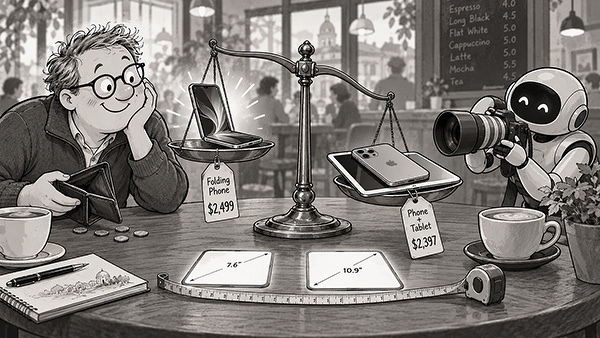
What if you just bought an iPhone 18 Pro and an iPad mini instead?
My suspicion was that the pair would be cheaper, with a better camera and a bigger screen, at the cost of carrying more. I ran the numbers. Most of that holds. The price part only holds once you look past the checkout.
The price gap is A$101
Apples to apples (sorry), everything at 256GB, Apple Australia list prices:
| Device | 256GB price |
|---|---|
| iPhone Duo | A$3,499 |
| iPhone 18 Pro | A$2,099 |
| iPad mini (A20 Pro) Wi-Fi | A$1,299 |
| iPhone 18 Pro + iPad mini | A$3,398 |
The new iPad mini starts at A$1,099 for 128GB, per TechRadar. The Apple Australia store now lists the 256GB Wi-Fi model at A$1,299, ahead of pre-orders opening at 4:10 am AEDT on Thursday.
So the pair is cheaper. By A$101. That’s 2.9%.
Choose the cellular iPad and the maths flips. At A$1,549 the combo costs A$3,648, which is A$149 more than the Duo. My advice is to skip cellular anyway. The iPhone’s hotspot does the job for free.
On day one, “cheaper” is technically correct. But nobody buys these devices for one day.
Over a decade the gap is A$4,402
Phones and tablets don’t live the same lives. An iPhone goes in and out of a pocket all day. It gets dropped, sat on and charged twice a day. An iPad mostly lives on the couch, the bedside table or in a bag. iPads are very well engineered and they last. Plenty of people still use one they bought five years ago.
The tablet also doesn’t need the latest tech. The best camera matters on the phone, because that’s the camera you actually carry. On a tablet you read, watch, write and sketch. An A20 Pro will still be overkill for that in 2031.
So model it the way people really upgrade. iPhone every two years, iPad every five. Over ten years, at today’s prices:
| 10-year cost | Purchases | Total | Per year |
|---|---|---|---|
| iPhone Duo every 2 years | 5 x A$3,499 | A$17,495 | A$1,750 |
| iPhone 18 Pro every 2 years | 5 x A$2,099 | A$10,495 | A$1,050 |
| iPad mini every 5 years | 2 x A$1,299 | A$2,598 | A$260 |
| iPhone + iPad | A$13,093 | A$1,309 |
The pair saves A$4,402 over the decade. That’s A$440 a year, or 25%. Even with the cellular iPad the saving is A$3,902.
The Duo has no way to make this argument back. Its big screen is bolted to the phone, so it gets replaced on the phone’s cycle. Every two years you pay for a new tablet whether the old one was tired or not.
The assumptions are generous to the Duo. Prices are held flat, which Apple’s two rounds of price increases this year suggest is optimistic for everything. Trade-ins are ignored. If I had to guess, a two-year-old foldable with a creased inner screen will trade in worse than a two-year-old iPhone 18 Pro, which would widen the gap further. That’s speculation until the resale data exists.
The camera gap is enormous
This is where the Duo gives the game away. Apple fitted it with a two-camera system: a 48MP main (26 mm, f/1.6), a 48MP ultra wide and a 2x crop from the main sensor. Digital zoom tops out at 10x.
The iPhone 18 Pro has the full Pro kit. A 48MP main with the new variable aperture (f/1.48 to f/4.0), a 48MP ultra wide and a 48MP 4x tetraprism telephoto that also delivers 8x at 200 mm with optical quality. Digital zoom reaches 40x.
The quieter difference matters more to anyone serious about photos. According to Apple’s own spec sheets, the Duo captures HEIF and JPEG only. No ProRAW. Video is HEVC and H.264. No ProRes, no Apple Log 2. The 18 Pro does all of it.
For the price of the most expensive iPhone ever made you get a camera system closer to the base iPhone 17. That is a deliberate product decision, and it’s the wrong one at A$3,499.
The screen comparison is closer than it looks
Apple quotes the Duo’s inner display at 7.6 inches and the iPad mini at 8.5 inches. Diagonals flatter and mislead, so I worked out the actual areas from Apple’s published resolutions and pixel densities.
| iPhone Duo (open) | iPad mini | |
|---|---|---|
| Diagonal (as a rectangle) | 7.58 in | 8.5 in |
| Dimensions | 11.1 x 15.8 cm | 11.8 x 18.0 cm |
| Screen area | 175 cm² | 213 cm² |
| Aspect ratio | 1.42:1 | 1.53:1 |
| Resolution | 1878 x 2670 | 1512 x 2316 |
| Pixel density | 430 ppi | 326 ppi |
| Refresh rate | up to 120 Hz | 60 Hz |
| 16:9 video area | 140 cm² | 183 cm² |
The iPad mini has 22% more screen. Watch a widescreen video and the gap grows to 31%, because the Duo’s squarer panel letterboxes harder. There’s also a crease down the middle of the Duo, which Apple minimises but doesn’t eliminate.
But the Duo’s panel is the better screen. It pushes 43% more pixels into a smaller area, runs ProMotion at 120 Hz and hits 3,000 nits outdoors. The iPad mini’s OLED is lovely, yet Apple still hasn’t given it ProMotion, and MacRumors confirms it stays at 60 Hz.
Bigger, yes. Better, no.
Closed, the comparison reverses. The Duo’s outer screen is 5.36 inches (87 cm²). The 18 Pro is 6.27 inches (96 cm²). In phone mode, which is most of the day, the standard iPhone wins.
The bulk is real
| iPhone Duo | iPhone 18 Pro + iPad mini | |
|---|---|---|
| Weight | 254 g | 466 g (211 + 255) |
| Volume | 112 cm³ | 234 cm³ |
The pair weighs 83% more and takes up twice the space. More to the point, the iPad doesn’t go in a pocket. The Duo’s big screen is always with you. The iPad mini’s big screen is with you when you remembered to bring the bag.
That’s the Duo’s strongest argument, and it’s a genuine one.
A few things that tip it further
The 256GB iPad mini gets a cut-down A20 Pro with a five-core CPU. Only the 512GB model gets the full six-core chip found in both phones. For reading, video and notes you will never notice.
Two devices means two batteries. When the phone dies, the tablet doesn’t, and you can hand the iPad to someone else at the cafe table while still taking calls.
The repair bill on a foldable is a different order of magnitude. Reported US out-of-warranty pricing puts an inner-display replacement on the Duo at US$999. Budget for AppleCare if you buy one.
The Duo also gets Apple Pencil (USB-C) support later this year. The mini already supports Pencil Pro, with hover and squeeze.
The verdict
My contention mostly survives contact with the numbers.
The camera: emphatically better on the 18 Pro. Not close.
The screen: 22% bigger on the iPad, but the Duo’s is sharper and smoother.
The price: a wash on day one. A$4,402 cheaper over ten years.
The bulk: 212 g heavier and twice the volume. Confirmed.
So the pitch for the pair isn’t a cheaper checkout. It’s a cheaper decade, with a much better camera, a bigger reading and viewing screen, two batteries and a phone that’s better in the pocket. You give up the magic trick of one device that becomes another.
Let’s keep perspective, though. Having both, or an iPhone Duo, is a luxury and far from essential. These are all now expensive devices. A$1,300 a year to stay current is a lot of money for anyone, and a good phone from three years ago still does almost everything these do.
But if you’re going to spend it, spend it on the pair. The Duo is the more impressive object. The iPhone and iPad are the better purchase. And if you can wait, a second-generation Duo with a proper camera and a price that starts with a two might change the answer.
Sources:
- iPhone Duo: Apple’s first foldable iPhone costs $3,499 in Australia - Finder
- Buy iPhone Duo - Apple Australia
- Buy iPhone 18 Pro - Apple Australia
- iPhone Duo technical specifications - Apple Australia
- iPhone 18 Pro technical specifications - Apple
- iPad mini - Apple Australia
- Buy iPad mini - Apple Australia
- Apple’s new OLED iPad mini is here - TechRadar