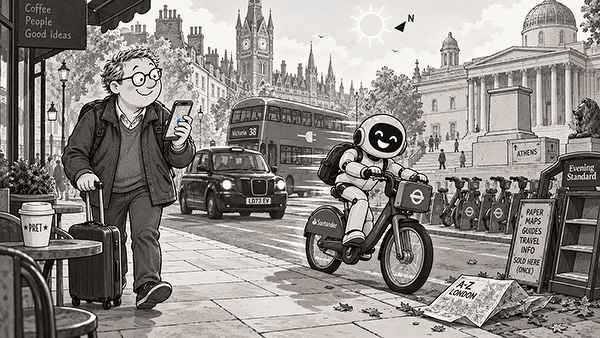
Lovely to visit, wouldn’t want to live there. That’s been my verdict on London since our honeymoon in 1993, and visit 15 didn’t change it.
In between I’ve been back for work, for family and for holidays. No offence to Londoners - I’m just not a big city guy.
London itself, though, has changed plenty. Looking back over three decades of visits, a handful of changes stand out. Most of them have made the place easier to explore and more liveable.
Finding my way
London used to be a tricky place to get around unless you had an A-Z in your pocket. Even with one, my inner compass was always off kilter.
It took me a while to work out why. As an Aussie, I instinctively expect the sun to be in the northern sky. In London, of course, it is not. Until I was lost for the umpteenth time I hadn’t realised how my instincts were betraying me.
Now I carry a pocket GPS - my iPhone - with Google Maps and Apple Maps. Getting from A to B is easy, and both apps make navigating the Tube a breeze: which line, which direction, where to change.
Tap and go
Tickets got the same treatment. No queuing for paper tickets, no need for an Oyster card. Tap your bank card or phone on the bus or at the Tube gates and go.
Contactless payment arrived on London’s buses in December 2012 and on the Tube and rail network in September 2014. Daily and weekly fare caps mean you never pay more than a travelcard would cost. One less thing to think about.
Quieter, cleaner streets
Most of the black cabs are now electric, and so are many of the buses. The result is a noticeably quieter and cleaner London.
The numbers back up what my ears were telling me. Every taxi licensed in London for the first time since 2018 has had to be zero-emission capable, and more than half the black cab fleet now is. On the buses, TfL now runs more than 3,000 zero-emission buses, about a third of the fleet, up from just 30 in 2016. Every new bus since 2021 has been zero-emission at the tailpipe.
Bikes everywhere
A good choice of rent-and-go bikes plus lots of dedicated bike lanes has transformed London.
The red Santander Cycles (still known to many as Boris Bikes) launched in July 2010 and have grown to around 800 docking stations and more than 12,000 bikes. Add the dockless e-bikes and the city looks very different from the 1990s.
A word of warning for pedestrians: stay alert. Near silent, zippy cyclists whizz about from every direction. The “LOOK RIGHT” painted at the kerb will save you from a bus. It won’t save you from an e-bike.
King’s Cross cleans up
We’ve often stayed central in King’s Cross, which is convenient for family. Thirty-odd years ago it was the shady red light district. Now it’s thoroughly gentrified, and rents and hotel rates have gone up accordingly.
I prefer cleaner and safer. It’s not so easy for the people who have to live here and meet the higher living costs.
Coffee, finally
Thirty-odd years ago, getting a coffee in London meant a cup of Nescafé Blend 43 or International Roast. Yuk!
Now there are plenty of good choices, from the chains (skip Starbucks and their oversweetened coffee “treats”) to independent cafes that are on par with the standard we’ve come to expect in Australia. It helps that a wave of Aussie and Kiwi expats spent the 2000s teaching London what a flat white is.
I try not to think about the cost. London remains expensive, not helped by 20% VAT and our weaker Australian dollar.
Where did the newspapers go?
Thirty-odd years ago newspaper sellers were everywhere, with morning and evening papers readily available.
Now you rarely see anyone reading a paper on the Tube. Instead most people are absorbed in their smartphones, sucking down memes and nonsense.
The clearest marker: the Evening Standard ended its daily print edition in September 2024 after almost 200 years, with its owners partly blaming the arrival of wifi on the Underground. The phones didn’t just replace the paper. They killed it.
Brexit, barely noticed
Despite the stupidity of Brexit - the first time a nation has imposed trade sanctions on itself - the effect on everyday tourists doesn’t seem apparent.
The one place a visitor does feel it is the wallet. When the transition period ended, the UK scrapped VAT-free shopping for overseas tourists from 1 January 2021. So that 20% VAT on your flat white? It now applies to the cashmere scarf as well.
Free museums, stolen marbles
London remains a destination for history and culture, and the British Government should be commended for the large array of free museums it offers the visiting public.
Universal free entry to England’s national museums began on 1 December 2001, so it turns 25 in a few weeks. Last month the government ruled out charging overseas visitors, despite months of speculation that it might. Good call.
Now if only they’d give the Greeks back the marble statues they stole from the Parthenon - the so-called Elgin Marbles.
Don’t hold your breath. Talks between Greece and the British Museum reportedly collapsed in September over ownership, and this month Athens rejected George Osborne’s plan to rotate the sculptures between London and Athens. The British Museum still hides behind the British Museum Act 1963, which bars it from permanently giving anything away.
The irony is hard to miss. The same museum currently has the Bayeux Tapestry on loan from France. Borrowing other nations' treasures and handing them back is apparently fine. Handing back the ones you took is not.
Fifteen visits in, London keeps getting easier to visit. Still wouldn’t want to live there. But on visit 16, I’d love to find Room 18 at the British Museum empty and the marbles back home in Athens where they belong.
Sources:
- Contactless payment on London Underground - Transport for London
- London reaches 3,000 zero-emission buses - Sustainable Bus
- London’s Evening Standard to close daily print edition, launch weekly - Sharecast
- The impact of ending tax-free shopping on the UK and London economies - London Datastore
- Free forever: government rules out entry charges for overseas visitors to national museums - Museums Association
- Greece rejects Parthenon Sculptures sharing plan - Greek City Times