TL;DR CREA says Americans paid the most for the Hormuz fuel shock: US$471 a head. Adjust for purchasing power and the US is still first, but Canada ties it, Guyana jumps from 20th to 3rd and Iceland falls from 6th to 19th. As a share of household spending, the US drops to 14th of 19 and Australia sits at about 1% so far. The bill is still growing, and refining capacity can’t be swapped around quickly. The lasting fix is to need less oil.
Americans have paid more for the Hormuz fuel shock than anyone on Earth. US$471 a head since the start of March. In US dollars, that’s true. But it doesn’t describe the full impact globally.
It comes from a new analysis by the Finland-based Centre for Research on Energy and Clean Air (CREA). Lauri Myllyvirta’s report, US paying most for Hormuz oil shock, puts the world’s extra spend on diesel and petrol at US$468 billion, about US$60 a person. Reuters picked it up and the chart is doing the rounds on Threads captioned “The US was hit extremely hard.”
It’s careful work. But the catch is in the subtitle: USD per person. Every country is converted at market exchange rates, and a US dollar doesn’t buy the same amount of life in Reykjavík as in Riga.
So I rebuilt it.
What purchasing power parity does
Purchasing power parity (PPP) is the exchange rate that makes the same basket of goods cost the same everywhere. The World Bank prices thousands of items - rent, bread, haircuts, bus fares - across nearly every country to work out how much local currency buys what US$1 buys in the US. That unit is the international dollar.
Market exchange rates tell you what a currency is worth to someone buying dollars. PPP tells you what it’s worth to someone buying groceries. The gap is big. A Swiss household pays about 29% more than an American for the same basket. A Guyanese household pays less than half.
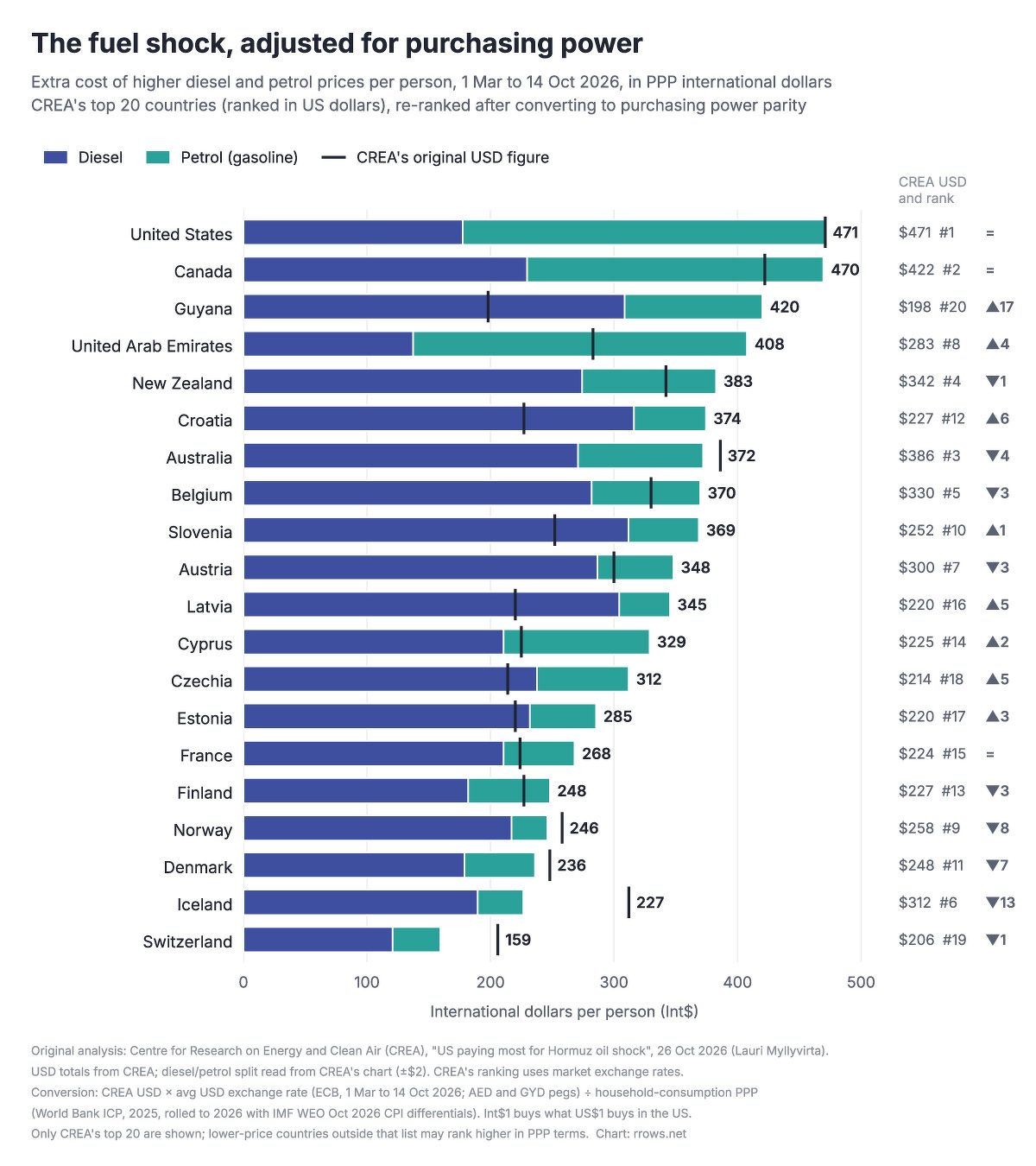
I converted CREA’s figures back to local currency at the period’s average exchange rate, then divided by the World Bank’s household consumption PPP, rolled forward to 2026 with IMF inflation forecasts.
The ranking reshuffles
The US stays on top at Int$471. By definition a US dollar is an international dollar.
What changes is who sits beside it. Canada ties at Int$470. Guyana leaps from 20th to 3rd, Croatia climbs six places and the UAE moves into fourth.
The expensive countries head the other way. Iceland drops from 6th to 19th. Norway and Denmark fall eight and seven places. Switzerland finishes last at Int$159.
Market exchange rates inflate the cost in rich, high-price countries and shrink it in cheaper ones. A Latvian paying US$220 extra for fuel has given up Int$345 of everything else. An Icelander paying US$312 has given up Int$227.
Australia drops from 3rd to 7th. In our money it’s about A$546 per person, which squares with the A$550 Yahoo Finance reported. Almost three quarters of our bar is diesel. The US shock lands at the bowser. Ours lands on trucks, mines and farms, then on the price of everything that moves by road.
The measure that matters most
PPP tells you what the bill was worth. It doesn’t tell you how much it hurt. For that, compare it with what people actually spend.
The table divides each country’s 7.5-month cost per person by a full year’s household spending per person (World Bank, latest year), then annualises it. It’s spending that fuel has displaced, not added. And because CREA counts all diesel and petrol, some of it reaches households indirectly, through freight costs.
| Country | Equivalent share of a year’s household spending (7.5 months) | Annualised |
|---|---|---|
| Croatia | 1.46% | 2.34% |
| Latvia | 1.42% | 2.27% |
| Canada | 1.35% | 2.16% |
| Cyprus | 1.29% | 2.07% |
| Slovenia | 1.28% | 2.05% |
| United Arab Emirates | 1.27% | 2.03% |
| New Zealand | 1.26% | 2.02% |
| Czechia | 1.21% | 1.94% |
| Estonia | 1.19% | 1.91% |
| Australia | 1.04% | 1.66% |
| Belgium | 1.02% | 1.63% |
| Austria | 0.90% | 1.44% |
| France | 0.83% | 1.33% |
| United States | 0.80% | 1.28% |
| Finland | 0.78% | 1.25% |
| Denmark | 0.72% | 1.15% |
| Iceland | 0.61% | 0.98% |
| Norway | 0.59% | 0.94% |
| Switzerland | 0.35% | 0.56% |
The “hardest hit” country falls to 14th of 19. For an average Australian household of 2.5 people, it’s about A$1,350 so far. (Guyana lacks recent household spending data.)
None of this makes CREA wrong. Their real point stands: Americans pay the most because they burn the most fuel and have been slowest to electrify. Plug-in EVs are 7.3% of US new car sales this year, against 57% in China and 98% in Norway. A US EV driver has paid about US$17 more to charge since March. A petrol driver has paid US$440.
This is only the bill so far
Everything above runs to 14 October. The meter is still running.
The Strait of Hormuz is still effectively shut. IMF PortWatch logged four transits on 18 October, against 85 a day before the crisis. A US-escorted corridor moves about 30 ships a day. Brent sits around US$116.
Reopening the Strait won’t fix diesel on its own, because the war hit refineries too. By May up to 3.52 million barrels a day of refining was shut, including Saudi Arabia’s Ras Tanura and Kuwait’s three major refineries.
Russia squeezes from the other side. Its invasion of Ukraine is in its fifth year, and Ukrainian drones have hit the world’s second-largest diesel supplier where it hurts. By mid-September three of Russia’s six biggest diesel refineries were shut or crippled, and Moscow has restricted diesel exports. Together, Columbia University estimates, these shocks have disrupted 20% of the world’s seaborne diesel.
Refining capacity isn’t fungible
Crude oil is close to fungible. A barrel is a barrel, give or take a discount. Refining capacity isn’t.
Every refinery is built around a range of crudes (light or heavy, sweet or sour) and a set mix of outputs: petrol, diesel, jet fuel, bitumen and petrochemicals. Diesel depends on specialised hydrocrackers and desulphurisation units. Operators can tweak the blend and shift output a few points between petrol and diesel. Beyond that, you need new hardware.
So a diesel refinery knocked out in Kuwait or Russia can’t be replaced by running a petrol-oriented plant elsewhere harder. In March, Australia temporarily allowed higher-sulphur fuel imports just to widen the pool of refineries it could buy from.
We’re exposed. We import 85 to 90% of our refined fuel and have two refineries left of eight. Singapore and South Korea supply over half, and Singapore gets two thirds of its crude from the Middle East.
New capacity takes years. Nigeria’s Dangote refinery began construction in 2016 and didn’t produce petrol until September 2024.
The durable fix is to need less oil. For Australia that means the car fleet, and the harder job of the trucks, mines and farms that burn most of our diesel.
The US dollar is a fine way to add up a global bill. It’s a poor way to compare who paid it.
Sources:
- US paying most for Hormuz oil shock with world’s largest fuel bill - CREA (Lauri Myllyvirta)
- PPP conversion factor, household final consumption expenditure - World Bank
- Households final consumption expenditure - World Bank
- Beyond Crude: Iran War Reveals Refined Products as an Energy Security Blind Spot - Columbia University Center on Global Energy Policy