Eleven Studio Ghibli films are leaving SBS On Demand in April. All gone between April 17 and 20. If you’ve been meaning to work through Miyazaki’s catalogue (or introduce someone to it), this is your window. More on the best watching order below.
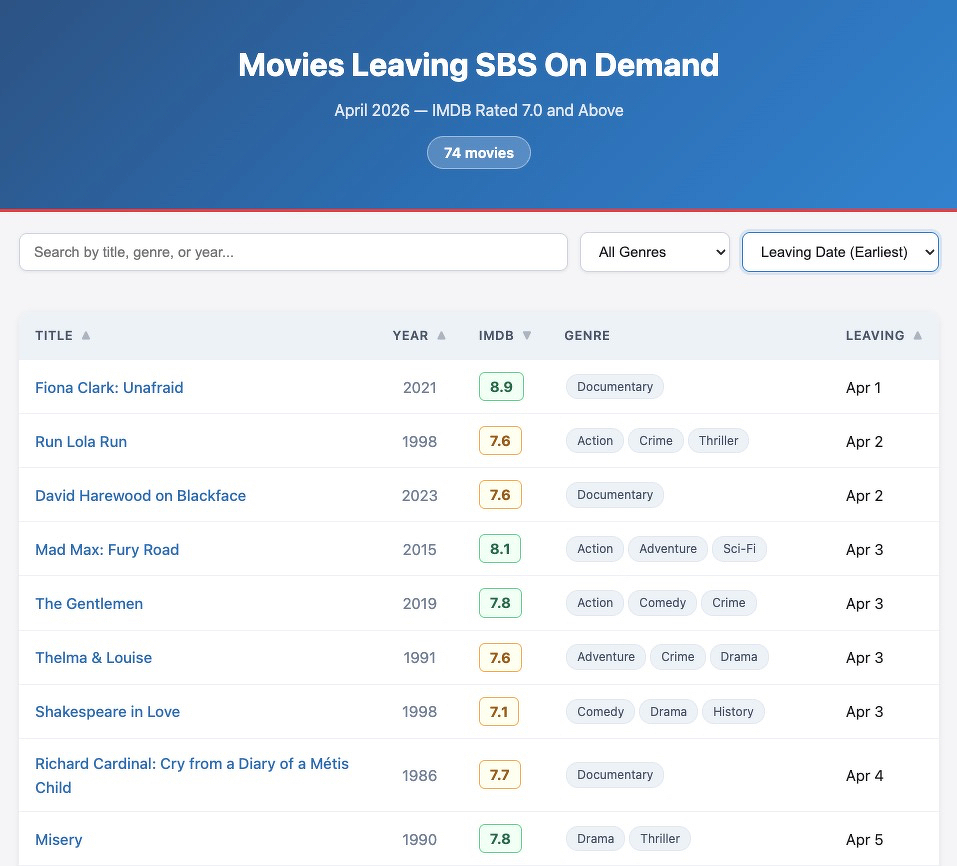
I ran the same process as last month: feed Claude the SBS “what’s leaving” page, filter out series, cross-reference every standalone title against IMDB, keep anything rated 7.0 or above. Six parallel agents, four minutes, done.
March turned up 57 qualifying films. April has 74. The bump is partly a massive April 30 purge (29 of the 74 leave on the last day) and partly that SBS continues to quietly stock one of the best international catalogues in Australia.
Beyond the Ghibli haul, the highlights are varied. Mad Max: Fury Road (8.1) leaves April 3, so that’s already urgent. Platoon (8.1), Blood Diamond (8.0) and Manon des Sources (8.0) are the other heavy hitters. Flee (7.9), the animated documentary about an Afghan refugee, is one of the best films most people haven’t seen. Red Rooms (7.1) is a Canadian courtroom thriller worth your time if you can handle the subject matter. And the entire Pusher trilogy (all 7.3) from Nicolas Winding Refn’s pre-Drive era disappears on the 30th.
The full sortable, searchable list is here: Movies leaving SBS On Demand, April 2026 (IMDB 7.0+).
Same caveat as last time: a few obscure documentaries carry high ratings on very few votes. Treat anything you haven’t heard of with a healthy glance at the vote count.
The Ghibli watching order
If you’re new to Studio Ghibli, don’t start at random. These eleven films span four decades of Hayao Miyazaki’s career (plus a couple from other Ghibli directors), and the order matters.
Start with Spirited Away (8.6). It’s the consensus masterpiece, the Oscar winner, and the most accessible entry point. A resourceful girl trapped in a spirit world, no clear villain, and an emotional core that sneaks up on you. If you only watch one, make it this.
Follow it with My Neighbour Totoro (8.1) for the gentler end of the spectrum. Two sisters in rural Japan befriend forest spirits. It’s deceptively simple and quietly devastating if you know what’s going on beneath the surface.
Then Princess Mononoke (8.3) for the epic, morally complex end. A war between industrialisation and forest gods where neither side is wrong. This is where Ghibli’s environmental themes hit hardest.
From there, in roughly this order:
Howl’s Moving Castle (8.2). The most romantic. A young woman cursed into an old body finds herself in a walking castle run by a vain wizard. Looser narrative than the others, gorgeous world.
Castle in the Sky (8.0). Ghibli’s first film and their purest adventure. Flying cities, sky pirates, a lost civilisation. The most Spielbergian of the lot.
Nausicaä of the Valley of the Wind (8.0). Technically pre-Ghibli (1984) but foundational. Ecological sci-fi set in a post-apocalyptic toxic jungle that’s actually healing the earth. The film that launched the studio.
Kiki’s Delivery Service (7.8). The cosiest. A young witch moves to a new city, starts a delivery business, loses her confidence, gets it back. It’s a film about creative burnout disguised as a children’s movie.
Porco Rosso (7.7). The most idiosyncratic. A WWI Italian fighter pilot cursed into a pig, flying bounty hunter missions over the Adriatic. Widely regarded as Miyazaki’s self-portrait.
Ponyo (7.6). Miyazaki’s riff on The Little Mermaid, aimed at younger audiences. Pure visual joy, less narrative complexity.
The Secret World of Arrietty (7.6). Directed by Hiromasa Yonebayashi, not Miyazaki. Tiny people living under the floorboards. Quiet, miniature-scale charm.
The Boy and the Heron (7.3) last. Miyazaki’s final film (2023), and the most personal and abstract. It’s dense with self-reference and works as a capstone to his career. Watching it first would be like starting Radiohead with A Moon Shaped Pool.
You’ve got roughly two weeks before they start disappearing. A Ghibli film every day or two is actually the ideal pace. They benefit from not being binged.