My last website was built in 2014. Not “maintained in 2014” - built from scratch, tweaked, launched and then mostly left alone. Since then, the skills have sat in a corner gathering dust, relevant only to projects that drifted off the priority list and stayed there.
So when I recently spun up something new and realised the www subdomain wasn’t resolving - visitors typing www.whatever were hitting nothing - I did that familiar thing: the slow, reluctant calculation of how much time it was going to take to remember what a DNS record even is, which type I needed and where exactly in the interface the setting lived.
I logged into Cloudflare. And then, mostly out of curiosity, I tried the help bot.
What happened next was not what I expected from a help bot.
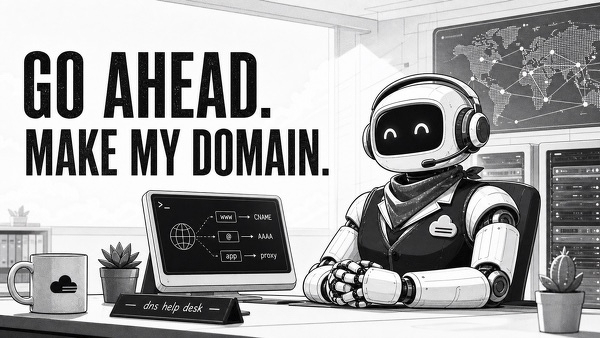
It didn’t hand me a link to a knowledge base article. It didn’t serve up a three-step explainer written for someone who does this every week. It asked what I needed, worked out what records I already had, figured out what was missing - and then walked me through creating exactly the right record: a CNAME pointing www to the root domain, proxied through Cloudflare.
Done. Problem solved. Twelve years of rust cleared in about three minutes.
I’ve used a lot of help bots. Most of them are sophisticated keyword matchers in a chatbot costume. You describe your problem, they retrieve the documentation, and you end up exactly where you would have been if you’d just searched the help centre yourself - except you’ve also spent five minutes in a chat window feeling vaguely annoyed.
The Cloudflare bot was doing something different. It was reasoning about my actual situation: looking at what records I had, inferring what I needed and offering specific guidance - not generic documentation about what DNS records are and why they matter.
This is the distinction that actually matters. There is a chasm between a tool that retrieves information and one that applies it.
The business case for getting this right is obvious, even if most companies are still fumbling it.
Cloudflare is not a product I use every day. It sits in the background doing infrastructure things I don’t think about unless something breaks - which means every interaction I have with it arrives in a moment of mild stress. Something isn’t working and I need it fixed. How that moment goes shapes how I feel about the product.
A bot that makes me feel stupid, or sends me in circles, or hands me documentation I could have Googled - that’s a cost. A bot that solves my problem in three minutes is a win. Not just in the moment, but in the long memory that determines whether I recommend Cloudflare to someone else or mention it with a grimace.
This matters most for tools you only touch every few years. DNS configuration is not a skill most people are actively maintaining. For web professionals it’s second nature, but for the rest of us it’s a periodic encounter with a specialised domain we don’t live in. If your support experience assumes otherwise, you’re designing for the wrong user.
The companies that figure out how to build genuinely capable help - not documentation retrieval dressed up in a chat interface, but actual problem-solving - will accumulate goodwill in exactly these moments. And goodwill compounded over years of intermittent-but-positive interactions turns into loyalty that is genuinely hard to dislodge.
Most AI chat tools deployed today are still in the “retrieves documentation” camp. They are search engines with a personality, and users can feel the difference almost immediately. The bar for what passes as “AI-powered support” is currently set very low, which means the companies that actually clear it stand out sharply.
Cloudflare cleared it. The bot earned its keep. And now I’m writing about it.
That’s the real marketing strategy - build something genuinely useful, and let the people it helped do the rest.