 The Tifosi are furious, and they are aiming at the wrong target. The Ferrari Luce, Maranello’s first production electric car, was unveiled near Rome on 25 May to a wave of revulsion. “A Nissan Leaf with a prancing horse,” said the internet. Nissan, delighted, leaned in and thanked Ferrari for the compliment. The market was less amused. Ferrari shares fell more than eight per cent in Milan and over five per cent in New York the next morning. For a marque that has sold beauty for almost eighty years, that is a remarkable thing to do with a single reveal.
But the styling is not the story. The styling is a symptom.
The real reason Maranello blinked
The alternative read, and the one I find far more convincing, is that Ferrari and most of Europe’s premium makers are quietly terrified of China. Not the China of cheap imitation. The China that now builds the most advanced cars on the planet.
The direction of travel is not in doubt. The IEA’s Global EV Outlook 2026 has more than one in four new cars sold worldwide this year going electric. In China the figure is roughly 55%. More than half of every new car sold in the world’s largest car market is now an EV. This is not a forecast about 2035. It is happening now.
And the numbers underneath are not subtle. In 2025 BYD overtook Tesla as the world’s largest EV maker, taking 12.1% of the global battery-electric market against Tesla’s 8.8%, with exports tripling to over a million cars. That is not a fluke model. It is system competition: vertical integration, tight cost control and a portfolio that runs from cheap city cars to genuine luxury.
The up-and-coming Chinese consumer has fallen out of love with Western badges. They no longer lust after a prancing horse the way their parents did, because what is rolling out of Shenzhen and Hefei is already ahead. Deep digital integration, screens everywhere, cabin tech that makes a German flagship feel like a relic. The centre of automotive desire is shifting east, and it is shifting fast.
That shift erases the one thing Ferrari was built on: the performance moat.
EVs commodified the thing Ferrari sold
There was a time, and it was not long ago, when a sub-four-second sprint to 100 km/h demanded a V8, a V12 or something even more deranged. It burned petrol by the gallon and howled while it did it. That howl was the product. Lamborghini sold it too. So did McLaren. Acceleration was scarce, and scarcity is what you charge for.
Electric motors killed that scarcity overnight. Stack enough cells and a couple of fast-acting motors and you get brutal acceleration with no combustion, no drama and no exotic engineering. The Luce itself does 0 to 100 in 2.5 seconds and tops 310 km/h. Genuinely fast.
Now look down the other end of the market. A BYD Sealion 7 Performance does 0 to 100 in 4.5 seconds for about A$64,000. That is a five-seat family SUV, the kind of thing you load with kids and a week’s shopping, and it will keep a decade-old supercar honest off the line. The thing that justified a quarter of a million dollars in 2015 now comes standard in a school-run wagon. Sheer speed is no longer special. It has been commodified.
And really, who needs to hit 100 in four and a half seconds on a public road anyway. The acceleration arms race stopped being about usable performance long ago. It became theatre, and EVs have flooded it with cheap tickets.
When the headline number stops being special, the brand has to lean on everything else. And everything else is where the Luce gets interesting.
Break the car into three parts
Judge any car on three axes and the picture clears up. External styling. Performance and functionality. Interior design.
On performance and on the interior, Ferrari are kicking goals. The hardware is ferocious and the cabin, Ferrari’s first five-seater, is a genuine luxury statement. Nobody serious doubts that.
On styling, they have shocked their own faithful. And the most precise diagnosis came not from a fan but from a designer. Automotive designer Maurizio Corbi told Wired: “It’s clear that this is a product designed not by a car designer but by a product designer.”
Here is the detail that makes that line lethal. The Luce’s exterior and interior were shaped with LoveFrom, the studio of Jony Ive and Marc Newson. The man who gave the world the iPhone literally is the product designer. Corbi was not reaching for a metaphor. He was describing exactly what happened. The result is an appliance rendered beautifully. It is correct. It does not move you. A Ferrari is meant to be the poster a kid puts on the bedroom wall, and this one is not ending up on any walls.
Why the styling had to give
Here is the part the angry comment threads miss. The flat, product-like shape is not laziness. It is physics.
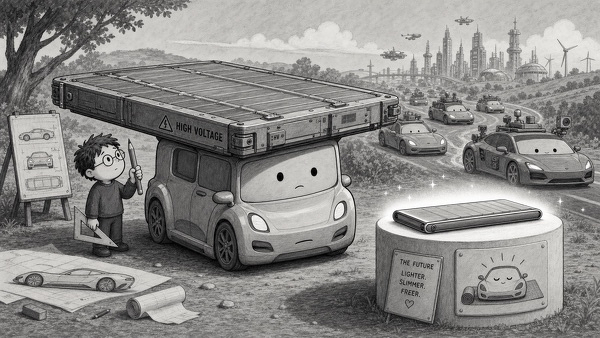
This connects directly to the battery packaging problem I have written about before. Energy density has improved, but the packaging volume has not shrunk anywhere near as fast as the marketing suggests. A usable battery is still a large, heavy, flat slab that wants to live in the floor.
That slab dictates the whole car. It raises the H-point, the height your hips sit at, and pushes the cabin up and out. It fights every instinct a sports car designer has, because a sports car wants mass low, a roofline slung close to the road and a body wrapped tight around the mechanicals. A skateboard battery architecture wants the opposite: a tall, slabby box, because that is the most efficient way to carry the cells and keep the range respectable.
So the designer is handed an impossible brief. Keep it light, keep it low, keep it zippy, keep the range, and do it all while building up and around a battery the size of a single bed. Something had to give, and what gave was the low, predatory drama that made a Ferrari a Ferrari.
This is a five-year problem
I do not think this is permanent. The trade-off that produced the Luce is a snapshot of where battery tech sits in 2026, not a verdict on EVs forever.
Solid-state and next-generation cells point at materially higher density in a smaller, lighter package. When the battery stops being a single bed and becomes a yoga mat, the constraint loosens and designers get their canvas back. They can drop the floor, slim the body and rebuild the low, mean proportions that combustion gave for free. I would bet the genuinely gorgeous electric Ferraris arrive in the back half of this decade, not now. (Speculation, but I would put money on it.)
The Luce is the awkward middle child. Caught between an old performance identity that EVs made commonplace and a new packaging reality the chemistry cannot yet escape.
What the Tifosi should actually fear
So direct the anger correctly. The Luce is not ugly because Ferrari forgot how to draw. It is awkward because the company is fighting a two-front war it did not start. A performance edge that electrification handed to everyone, and a battery that refuses to be shaped into a low-slung dream.
CEO Benedetto Vigna says the €550,000 car is already clocking up orders from old and new buyers, backlash or not. He may well be right in the short term. Scarcity and a badge will move the first batch regardless of what the internet thinks.
The deeper threat is not the look of one car. It is that the next generation of buyers, in Shanghai and Chengdu but also in Melbourne, London and Los Angeles, may decide that the prancing horse no longer says anything they want to hear. These are people who grew up with a touchscreen in their hand. For them the smartphone is the object of desire, the thing teenagers lust after the way earlier generations lusted after cars. By 15, around 95% of them own one. The iPhone is approaching twenty years old, which means the phone-obsessed 15-year-old of 2009 is a 32-year-old buyer today, entering peak earning years. They do not want a preserved monument to the twentieth-century automotive peak. They want a car as smart as the phone in their pocket. Ferrari’s whole pitch, the howl and the heritage, is aimed at a longing an entire generation simply does not feel.
That is what should keep Maranello up at night. Not a slabby roofline, but the possibility that the centre of desire has already moved, and the badge is now chasing it.
Beauty was always Ferrari’s answer to the question of why you would pay so much for so little practicality. The Luce quietly admits the question has changed. Whether Ferrari has the right answer is the only debate that matters.
Sources
- Is the Ferrari Luce design really that bad? We ask 3 Italian auto experts (Wired)
- Ferrari CEO says Luce EV is ‘clocking up orders’ despite design backlash (Electrek)
- IEA: Global EV sales headed for another record year, despite the slowdown (Electrek)
- 2025 BYD Sealion 7 Performance price and specifications (CarExpert)