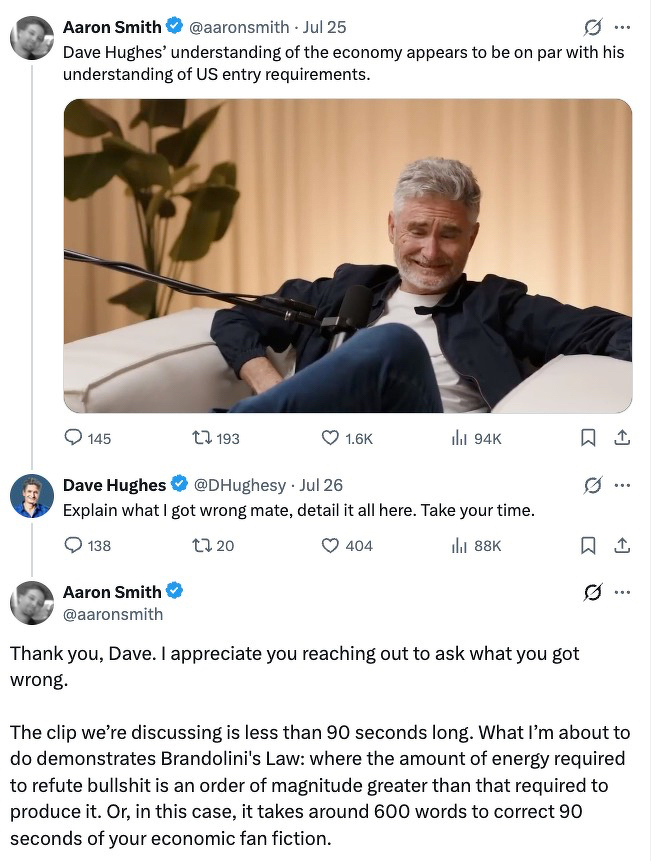
Dave Hughes went on a podcast, spent 90 seconds confidently rewriting Australia’s recent economic history, then dared someone to fact-check him. Someone did. It took about 600 words to correct 90 seconds of what the fact-checker called “economic fan fiction.”
Hughes is a television and radio personality and stand-up comedian. Lately he’s drifted into political and economic commentary, most of it aimed at the Federal Labor government’s tax policy changes. He’s understood to run a substantial investment portfolio of his own, like plenty of the policy’s other critics, largely exempt from the change thanks to grandfathering.
In the clip in question, Hughes slates previous governments, (always Labor), while dropping in “I might be wrong” and “I haven’t researched it” as he goes. Caveats are not the same as caution. If you haven’t researched something, the option not to broadcast an opinion on it remains open.
The dare
On 25 July, Australian commentator Aaron Smith posted: “Dave Hughes' understanding of the economy appears to be on par with his understanding of US entry requirements.” Hughes replied the next day: “Explain what I got wrong mate, detail it all here. Take your time.”
Smith took him up on it, opening with a warning about what he was about to do:
Thank you, Dave. I appreciate you reaching out to ask what you got wrong. The clip we’re discussing is less than 90 seconds long. What I’m about to do demonstrates Brandolini’s Law: where the amount of energy required to refute bullshit is an order of magnitude greater than that required to produce it. Or, in this case, it takes around 600 words to correct 90 seconds of your economic fan fiction.
The first 30 seconds
Hughes opens by conflating government debt with the Future Fund, seemingly under the impression the two can’t coexist. They can, and in Australia they do.
Australia’s Future Fund was established in 2006 with an initial govt investment of about $60B. Its first annual report, in 2008, showed assets of around $64 billion, not the $100B you suggested. Then, at around 27 seconds, you talk about the Future Fund as though it ceased to exist. It still very much exists Dave. In fact, it’s grown every single year since it was created. Today it’s worth around $270 billion, or over $330 billion once the other funds under management are included.
That’s the size of the fund wrong, its continued existence wrong, and government debt confused with a sovereign wealth fund, all inside 30 seconds.
The stimulus that wasn’t
At around the 32 second mark, Hughes claims Kevin Rudd PM used the Future Fund to “flush money through the economy” during the GFC. He didn’t. The Future Fund wasn’t touched for the stimulus and it didn’t build a single school hall.
The GFC stimulus was funded through government borrowing. For context, construction approvals were collapsing, more than a million Australians worked in construction, and the objective was to stop unemployment exploding during the worst global financial crisis in generations. You’re welcome to argue that was the wrong policy, but you didn’t. You’re not entitled to rewrite where the money came from.
Hughes does briefly concede “I might be wrong” around the 44 second mark. Smith’s response: “I concede you were correct during this part of the video.” It’s the only part.
What follows is the more interesting omission. Australia’s stimulus went largely direct to households rather than to rescuing financial institutions, unlike much of the response seen elsewhere. Counter-cyclical fiscal policy, in the jargon. Australia was one of only two OECD economies to avoid recession during the GFC. Whatever you think of the politics, that outcome isn’t contested.
The actual numbers
Hughes' recurring theme, on this clip and reportedly in general, is that Labor is responsible for Australia’s debt. Here’s net debt added by government since 2007, as Smith laid it out:
Rudd and Gillard added about $190 billion over six years. Abbott, Turnbull and Morrison added about $366 billion over nine years, roughly two-thirds of it before COVID. Albanese has added about $75 billion over four years. Whichever way you cut that ledger, it doesn’t tell the story Hughes has been telling.
Smith closed with this:
This isn’t about getting one date wrong or misremembering one statistic. Nearly every claim in your 90-second clip turns out to be either wrong or misleading. If you’re going to publicly lecture Australians about economic history, the bare minimum expectation is that you’ve first acquainted yourself with it. Because once the errors have been pointed out, as they have been to you multiple times, every repetition stops looking like an accident and starts looking like a strategy. Given your very public coffee with Angus Taylor (Opposition Leader) last week, perhaps people are entitled to ask what that strategy might be.
The thread had racked up 470,000 views by the time Smith posted that final line.
Hughes is entitled to his opinion. He’s not entitled to his own facts, and dares don’t work out well when the other side actually does the reading.
Aaron Smith should be congratulated for his fact checking efforts and brilliant written expose. Hughes is not the only ‘personality’ who is given broad media coverage to pump out fact-free opinions. If we met these characters nursing a beer at the local pub and sprouting off “The other day someone said to me …” we’d give them short shrift. Yet somehow the mix of ‘personality’ and ubiquitous media amplifies the spread of ignorance. Sadly, as is often the case, the ‘correction’ often gets far fewer views than the original mistake-ridden piece.
Sources
- Aaron Smith’s fact-check thread - X
- Dave Hughes bio - davehughes.com.au