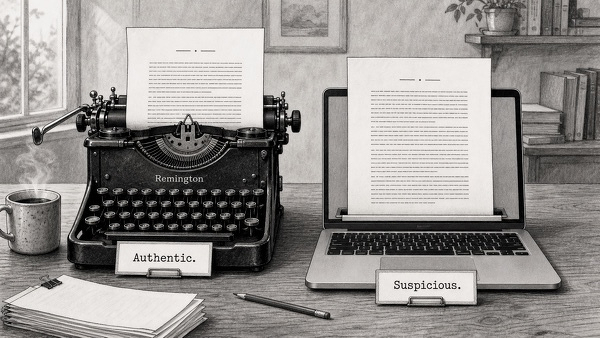
Jerry Falade’s crime novel won a 14-way auction for over $2 million. Then an AI detector read it.
Call Me, I’ll Hide the Body attracted bids from fourteen publishers. Minotaur, Macmillan’s crime imprint, won. Film rights were in play. By any measure, this was an excellent story. Then AI detection tools flagged “fingerprints,” Falade’s agent lost faith, and the deal collapsed.
Falade denied using AI, reasonably noting that these tools produce notorious false positives, and that multiple experienced editors read the manuscript without raising a single concern. Didn’t matter. Gone.
The actual reason is copyright, not purity
Let’s be honest about what’s really driving this. Publishers aren’t having an existential crisis about artistic purity. They’re worried about copyright registration. AI-generated text sits in a legal grey zone because it’s trained on copyrighted works: a publisher who buys an AI-assisted novel may not be able to register a clean copyright or defend a clear title chain in court. That’s a commercial problem, not a moral one.
That’s a legitimate concern. But it’s being dressed up as something it isn’t.
The tool doesn’t make the art
This is a work of fiction. A completely fabricated story. What now, they’re labelling it fake fiction? The entire point is that it didn’t happen and the author invented it. So why the hangup on the mechanism of invention?
We don’t cancel alcohol-enhanced writers. We don’t interrogate whether a novelist used dictation software, a structural editor, or, in a former era, the scandalous convenience of a word processor rather than a typewriter. Ghost-written books pour out of publishing houses without a second thought. Formulaic genre fiction comes off production lines and nobody calls it fraud.
The only coherent test for fiction has always been whether it’s excellent. Fourteen publishers in a competitive auction answered that question clearly.
The question worth asking
If copyright law can’t accommodate AI-assisted creative work, that’s a problem worth solving through updated law, openly debated, not through unreliable AI detectors and whisper campaigns. Falade may have used AI. He may not have. The detection tools are notoriously unreliable. The editors who loved the manuscript noticed nothing suspicious.
What the publishing industry has demonstrated here is that it will sacrifice a compelling debut novel rather than engage with an inconvenient legal question. That’s not a principled stand on authorship. It’s a dodge dressed up as one.
Sources: