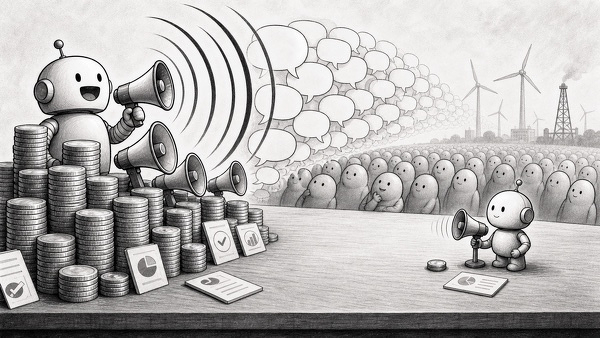
Clean energy still runs on the assumption that facts speak for themselves. Last month, fossil fuel groups spent 179 times more money betting that they do not.
The spending gap
RenewEconomy pulled the numbers straight from Meta’s ad library, and they are stark. In August, five fossil fuel organisations spent roughly $553,000 on political ads in Australia. The entire renewables industry spent $3,090. That is not a rounding error in a marketing budget. It is one side fully mobilised and the other side barely in the room.
The fossil fuel money broke down like this: the Australian Energy Producers spent about $200,000 promoting sector jobs, the Minerals Council of Australia spent about $200,000 including its “Hands off our fuel” campaign against abolishing the diesel rebate, Shell spent $136,000 polishing its low-emissions credentials, Farmers Fightback spent $33,000 in August alone (around $70,000 over three months), and the Christian Family First party chipped in $3,800.
On the other side, over the same four weeks, Acciona spent $1,500, Iberdrola spent $874 and the Clean Energy Council spent $716. Greenpeace ran its own $18,000 campaign, separate from the industry total. Add it all up and renewables still trail by a factor of more than 20 to 1, even with the activists included. Strip Greenpeace out and it is 179 to 1.
What fills the silence
Tom Quinn of Springmount Advisory called the renewables sector’s near-absence from paid advertising an “abject failure,” arguing clean energy has taken its social licence for granted for too long and leaned on NGOs to do the marketing work it should be funding itself.
Climate communications expert Belinda Noble put it more bluntly: minimal investment from the renewables sector “is leaving information gaps that are all too easily filled with misinformation, resulting in community backlash and political opportunism.”
That is the mechanism, not just a complaint. Coordinated astroturfing campaigns, fake accounts manufacturing local opposition to wind and solar projects, misleading political ads dressed up as grassroots concern. A parliamentary inquiry has already documented this pattern, alongside a new layer of AI-generated deceptive content that makes the fake grassroots look more convincing with each election cycle.
None of this is new, it is just under-resisted. A 2023 analysis by the Climate Investigations Center found the American Petroleum Institute alone outspent four combined renewable energy trade bodies on advertising by six to one. Different country, same imbalance, same three years of runway to entrench it.
Every dollar of that $553,000 is buying a story about energy policy that a community group, hearing nothing to contradict it, has no reason to disbelieve. Good policy does not lose arguments on the merits. It loses because nobody funded the other side of the conversation.
Sources:
- Outgunned: five fossil fuel lobbyists spent $553,000 on Meta ads in August, the renewables industry just $3,090 - RenewEconomy
- Trade Associations and the Public Relations Industry - Climate Investigations Center