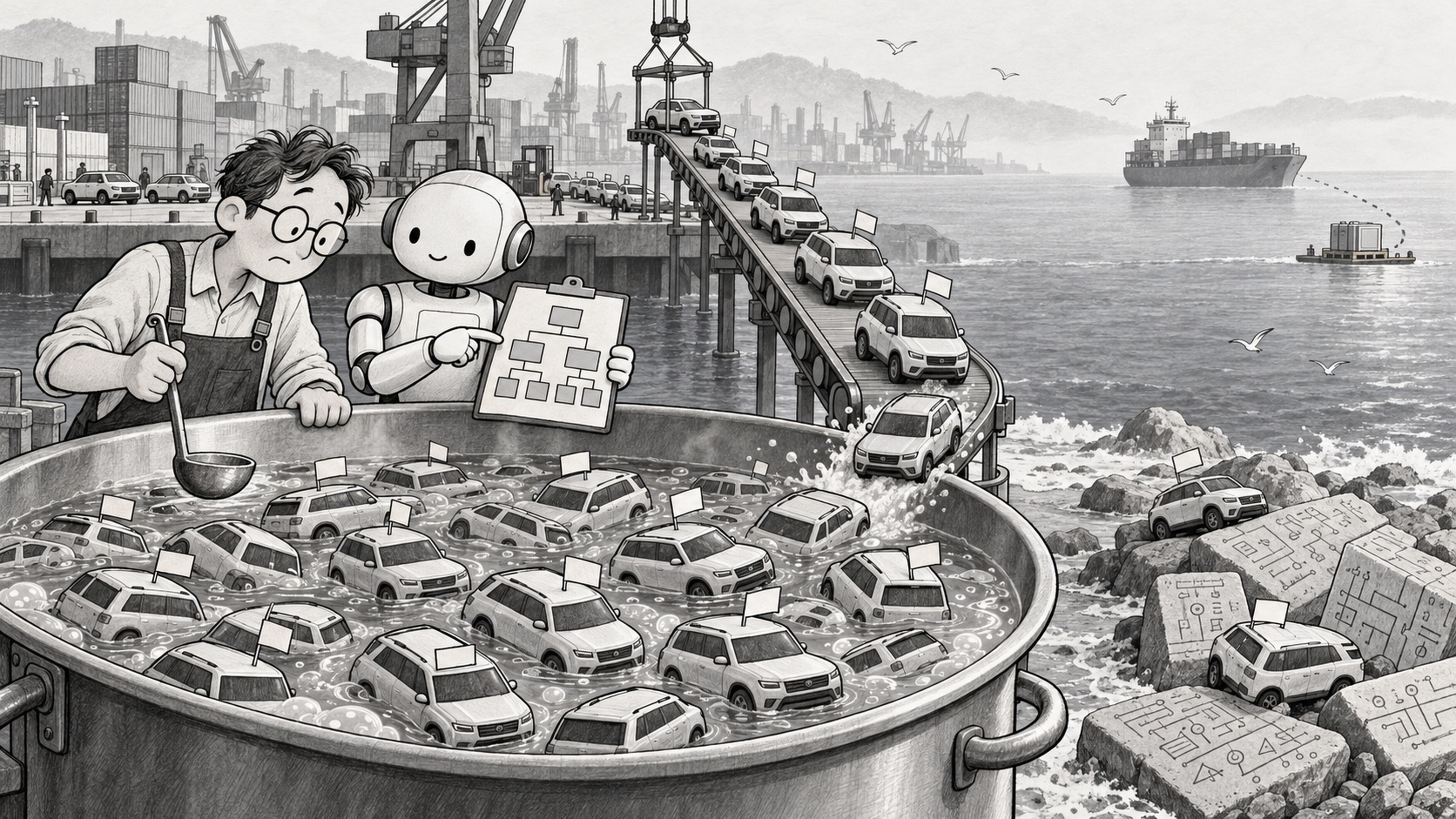
Australia has more than 70 car brands fighting over about 1.2 million sales a year. Another one has just been announced. Trying to keep track of the models and manufacturers is becoming like trying to spot the floating ingredients in a Sichuan hotpot.
Drive’s Jordan Hickey reports that Changan, the last of China’s big four carmakers to enter Australia, will launch a new factory-run subsidiary in 2027 and bring a sub-brand called Nevo. Avatr, its luxury brand, arrives first. Deepal, which Inchcape already distributes here, stays as it is. The first Nevo is a small SUV with a 51.9kWh LFP battery and a price tag somewhere between $30,000 and $40,000.
Changan’s own marketing head calls Nevo the “upper mainstream” brand, then concedes that some Nevo products may look better than Deepal even though Deepal ranks higher. If the company that makes them needs a diagram to explain the pecking order, what chance does a buyer in a showroom have?
I am an EV fan. They are the future. And let me be clear about the engineering, because this is not a post about quality: Chinese-made EVs seem to be among the best engineered cars of recent times. Every Tesla Model Y and Model 3 sold here comes from Gigafactory Shanghai, and the Model Y was Australia’s best-selling EV in June. Most iPhones are assembled in China too (India now makes about a quarter), and they are among the best-engineered pieces of electronics anywhere.
Nobody buys an iPhone worrying about where it was put together. So origin is not my concern. History is.
These brands are the biggest wave of new names the market has seen, with no long local histories and no established dealer and service networks. That makes them the most vulnerable when the market consolidates, and the owners of those models are the ones who wear the consequences. The difference between an iPhone and a Deepal is not the factory. It is who picks up the phone when something breaks.
How a small market got this crowded
Chinese brands have gone from 9.0 per cent of the Australian market to 25.8 per cent in four years, according to Pitcher Partners. The dealers' association puts them at 35.5 per cent in June and Chasing Cars says they stayed above 35 per cent in September, a month in which 26,287 of 108,778 new vehicles were battery electric.
Pitcher counts more than 20 Chinese brands on sale and about a dozen more coming (its chart has 20 this year and 32 in 2027), with models on sale jumping from roughly 72 to 120 next year. Carsguide’s roundup of Chinese brands runs to 28 names. Across the whole market there are more than 70 brands chasing about 1.2 million sales a year.
The sales are not spread evenly. BYD is second year to date with 76,614 sales. GWM, Chery and MG each sit above 36,000. Then the cliff.
BDO’s Sam Venn showed sales per dealer per month at an AADA event in March. The traditional top ten average 41. BYD managed 48. Then Zeekr at 13, Geely at 7, Leapmotor at 4, JAC at 3 and Deepal at 2. His verdict: “It’s not sustainable. It’s as simple as that.”
Who owns what
Most of the soup is a handful of parent groups running several brands each. Here is the map as it stands, with what is on sale and what is promised.
| Parent group | Brands in Australia | Still to come or in doubt |
|---|---|---|
| BYD | BYD, Denza | |
| Chery Group | Chery, Omoda, Jaecoo | iCaur, Lepas |
| Geely Holding | Geely, Zeekr, Smart (joint venture with Mercedes-Benz) | |
| SAIC | MG, LDV, IM (sold via MG) | Wuling |
| Great Wall (GWM) | GWM (Haval, Tank, Cannon, Ora) | Wey |
| Changan | Deepal (via Inchcape) | Avatr (2027), Nevo (2027) |
| GAC | GAC | |
| Independents | XPeng, Leapmotor (Stellantis-linked) | Nio, Skyworth (paused) |
| Others | JAC, Foton, Forthing | JMC relaunch |
Two things jump out. First, the groups are hedging by running a premium, a mainstream and a budget brand at once, which is how you end up with Chery, Omoda, Jaecoo, iCaur and Lepas all from one company. Second, the independents and the importer-distributed brands are the thin end of the market. Both are where the trouble starts.
What being stranded looks like
Start with the supply chain, because the battery point is real. Dealers told the Buchan Review for the dealers' association that parts which cannot be air-freighted, batteries among them, face the longest waits. Diagnosis alone can take six to eight weeks because of workshop backlogs, and some dealers refuse tow-ins on cars they did not sell. That is the healthy market. Buyback payments can take up to 18 months.
Now take the brand away. Your warranty is with the local importer, not the factory, so if the importer is liquidated you become an unsecured creditor. That same analysis expects used values to fall 40 to 50 per cent once an exit is announced. Mechanical parts are often generic. Software updates and cloud features are not.
The warning signs are already here. Skyworth’s BE11 was due by the end of 2025, then delayed, then parked in August. Its importer’s CEO said the market is “moving at lightning speed”. The Buchan Review notes XPeng took distribution back from TrueEV on 1 April and is in court with another distributor, though it says it will honour a late-2025 cashback promotion.
Inside China it is already worse. Yicai found almost 100 Neta owners complaining about quality and service, including one who waited over six months for a reducer still under warranty. The same part sold for almost 50 per cent more second-hand once the company’s troubles went public. Ji Yue, a Baidu and Geely joint venture, has closed its stores, and its driver-assistance features may not work without manufacturer support.
Australia has done this before. When Holden closed, GM promised warranties honoured and parts for at least ten years, and values still took a hit. Holden was a 70-year institution with a national network. Few of the new arrivals can offer that.
Who probably survives
BDO expects China’s carmaker count, now “well more than 150”, to shrink hard. The likely survivors are the big vertically integrated groups: BYD, Geely, SAIC, GWM and Chery. That is a short list, and it says something. A brand owned by a survivor may be folded, renamed or merged, but the parent has the money to honour a promise. A lone brand with one model and a third-party importer does not.
My own read, and this part is speculation: the real casualties will be the thin-volume brands, not the platforms. Expect parents to fold sibling brands together, which BDO warns could erase dealer networks altogether. An orphaned EV may also age better than an orphaned petrol car on mechanicals, but worse on software and the battery pack. A small independent battery refurbishing trade is the obvious gap in the market for anyone who wants one.
If you are buying now, the questions are boring and they matter. Is the importer owned by the factory? Does the parent make other brands that sell in real volume? Is there a local stock of battery packs, and what does the battery warranty say about delivery times? How many dealers does the brand have, and how many cars does each sell?
Australia does not need 32 Chinese brands by 2027. It needs a handful that will still be here, stocking parts and answering the phone, long after the warranty runs out. The cars will last that long. The question is whether the company behind yours will, so check it as carefully as you check the car.
Sources:
- Changan Nevo electric and hybrid cars coming to Australia as BYD and Geely rival - Jordan Hickey, Drive
- Chinese brands claim a quarter of Aussie auto market, but accounting firm says boom won’t last - Alborz Fallah, CarExpert (BDO analysis)
- New car component shortages prompt calls to overhaul Australian Consumer Law - CarExpert (Buchan Review)
- Flooding the zone: the rise of Chinese vehicle brands in Australia - Pitcher Partners
- Every Chinese car brand and car on sale in Australia - Carsguide
- Orphan brands: what happens if and when Chinese car brands leave Australia - Drive Electric