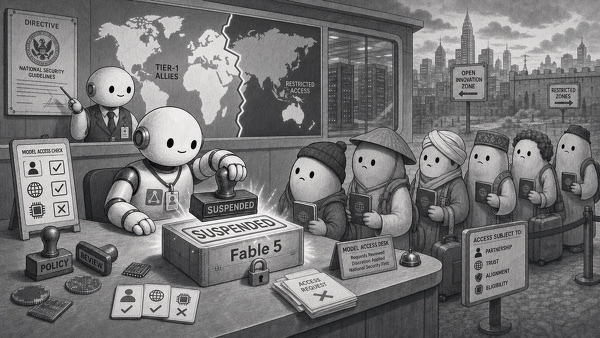
Anthropic launched Fable 5 and Mythos 5 last week. By the weekend, the US government had ordered both suspended for every foreign national on earth.
No advance notice. No specific public explanation. Just a directive citing national security, and Anthropic - with no practical choice - complied. Access to other Claude models remained unaffected. The concern, widely reported, centres on Mythos 5’s ability to detect software vulnerabilities. In the right hands it’s a security tool. In the wrong hands it becomes a cyberweapon. The US government has apparently decided it cannot control whose hands are whose.
This is what AI geopolitics looks like up close.
The policy backdrop is Biden’s AI diffusion framework, which created a three-tier licensing regime governing the export of advanced chips, model weights and access to compute power - the parameters that encode a frontier AI system’s intelligence.
“It seeks to encourage AI development in friendly nations and incentivize businesses around the world to adopt U.S. standards.”
Tier one - eighteen close allies including Australia, UK, Japan and Taiwan - gets essentially unrestricted access. Most of the world faces computing import caps unless they operate within certified, secure environments. Adversaries get blocked entirely. The Fable 5 directive goes further: it effectively treats the entire non-US world as a risk zone, at least for the most capable models.
China is pursuing the same goal - AI sovereignty - through a different set of levers. The US controls access. China controls ownership.
Beijing is happy for the world to use Chinese AI. Qwen, DeepSeek and a growing stable of open-weight models are freely and cheaply available globally. Wide adoption suits Chinese interests. A billion users running on Chinese models is its own kind of leverage. What Beijing will not tolerate is foreigners owning the companies that build them.
In March, that line was made explicit. Beijing effectively killed Meta/Facebook’s planned US$2 billion acquisition of Manus, a Chinese agentic AI startup that had attracted significant US venture capital. Meta is now unwinding the deal. US investors have been paid out. Chinese investors remain. The prevailing expectation is that Manus morphs into a fully Chinese-controlled entity, likely listed in Hong Kong - government direction with a functioning capitalist wrapper intact.
The strategies look different but the intent is the same. Both governments want their nation’s AI to be the infrastructure the world depends on. The US is trying to restrict who gets in. China is ensuring it never loses control of what it has built.
For Meta, the Manus collapse is another expensive dead end. The company remains 98% dependent on advertising revenue despite billions spent chasing AI and the metaverse. It needed a genuine AI acquisition. It got another write-off.
The Fable 5 suspension will likely be temporary. The broader dynamic it represents is not. AI is no longer a technology race between labs. It is an industrial policy race between governments. Both sides understand that whoever controls the infrastructure - the chips, the weights, the companies - controls what comes next.
The era of the globalised, borderless AI industry is closing fast.
Sources: