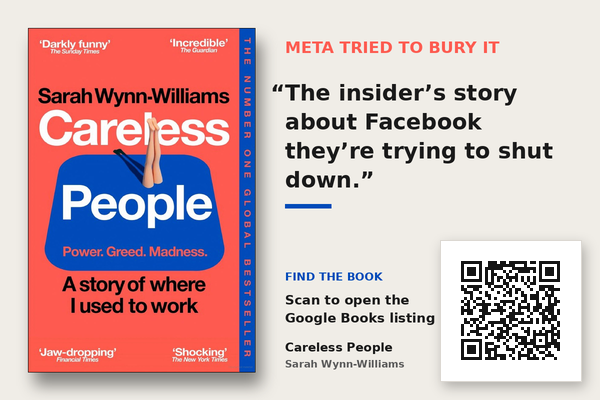
Meta has a court order stopping Sarah Wynn-Williams from promoting her own book. She cannot talk about it, cannot criticise the company, cannot even sit near a bookshop that stocks it without risking a fine. So let me do the promoting for her.
The book is Careless People: A Cautionary Tale of Power, Greed, and Lost Idealism. Wynn-Williams spent six years as Facebook’s global director of public policy. Her memoir is a first-hand account of what the company is like from the inside, and it is not flattering: allegations of sexual harassment, of courting Beijing with censorship tools, of contempt for the very users whose teenagers it studied.
Meta’s response was not to argue she was lying. It was to reach for an emergency arbitration ruling in March 2025, leaning on a non-disparagement clause in her severance deal, with fines reported at up to US$50,000 every time she speaks about the claims in the book. The order says nothing about whether a word of it is false. It just stops her speaking.
It has not worked. Careless People went straight to number one on the New York Times non-fiction list and has sold around 200,000 copies. The gag has not killed the book. It has only made Meta look frightened of it.
The night they blurred the cover
On 11 May 2026 Careless People won two prizes at the British Book Awards, the trade’s annual “Nibbies”: Audiobook Non-Fiction, and a share of the Freedom to Publish award. Wynn-Williams collected them on stage. Behind her, the image of her own book cover had been blurred out.
That was not the organisers' choice. In what her editor Mike Harpley called “an Orwellian development”, Meta had argued at the last minute that she “can’t even be in the vicinity of Careless People or its depiction”, so the cover could not be shown. Harpley read her statement from the podium, because she could not say it herself: “She is prevented from saying anything critical of Meta, in public, or even in private to her family. These restrictions mean she must constantly police her own life, facing life-changing fines for any breach.”
Sit with the absurdity of that. A company that built its empire on the promise of letting everyone share anything, going to court to make sure one woman cannot show the cover of her own award-winning book.
What she said instead
She shared the Freedom to Publish award with Virginia Giuffre, the woman who did more than anyone to expose Jeffrey Epstein, and whose memoir Nobody’s Girl was published after she took her own life in 2025. Barred from speaking about her own book, Wynn-Williams used her time on stage to speak about Giuffre. It is worth quoting her at length.
We are living in a world that now, more than ever, is dominated by networks of powerful elites whose wealth too often puts them above the law. As they rewrite rules, they grow arrogant with entitlement and impunity, often abetted by a legal system where justice has become a transaction, not a right. They control and shape institutions and social norms that train us not to see and not to say.
She praised Giuffre for telling the truth, “even if it destroys her”, then said this:
The people Virginia told us about had grown rich and powerful in the certainty that they would never be held to account. So they deployed every weapon that money can buy against a woman whose only weapon was her voice. They tried to exhaust her to make the cost of speaking so high, so relentless, so total that eventually the spirit gives out before the truth does. But here’s the strange thing: when you try that hard to silence a woman who is telling the truth, you announce to the whole world that the truth must be very dangerous indeed.
She was talking about Giuffre. She was also, unmistakably, talking about herself. Then she turned to why books in particular matter:
We live in an age where web pages disappear, where a single politically aligned billionaire can spike a news story or delete a viral video. But once a book miraculously makes it out into the world, onto a shelf, into a library, into a home, it cannot be disappeared. With analogue tenacity a book endures. Books are not monuments. They are instructions. Not merely to record what happened to one person. But to change the way the reader sees the world.
The Wynn-Williams effect
This is the Streisand effect at industrial scale. As the lawyer Larry Lessig points out, Sarah is gagged but the rest of us are not. He calls it the Wynn-Williams effect: if a court orders a whistleblower not to promote her book, then everyone else should do it for her. A blurred cover at an awards night is not a victory for Meta. It is a confession.
So here is the instruction, to borrow her word. I have a copy of Careless People on hold at my local library. Reserve one at yours, or buy it. That is the whole point.
Hat-tip to John Naughton, who put this story in front of me. His blog Memex 1.1 and the weekday newsletter that comes with it are an absolute gem. Do yourself a favour and subscribe.
Sources:
- Careless People: A story of where I used to work (Google Books)
- The British Book Awards blurs Sarah Wynn-Williams book cover due to Meta legal order (The Bookseller, Lauren Brown)
- Virginia Roberts Giuffre, Sarah Wynn-Williams share Freedom to Publish award at the 2026 British Book Awards (Publishing Perspectives, Andrew Albanese)
- Monday 22 June, 2026 (Memex 1.1, John Naughton)
- Let’s create the Wynn-Williams effect (Lawrence Lessig)
- Former Meta employee memoir Careless People prompts legal battle (Fortune)