Moonshot AI’s new flagship undercuts Claude Opus 4.8 on price and edges past it on the industry’s leading benchmark. The catch is that it isn’t actually open yet, and won’t be runnable by anyone outside a data centre when it is.
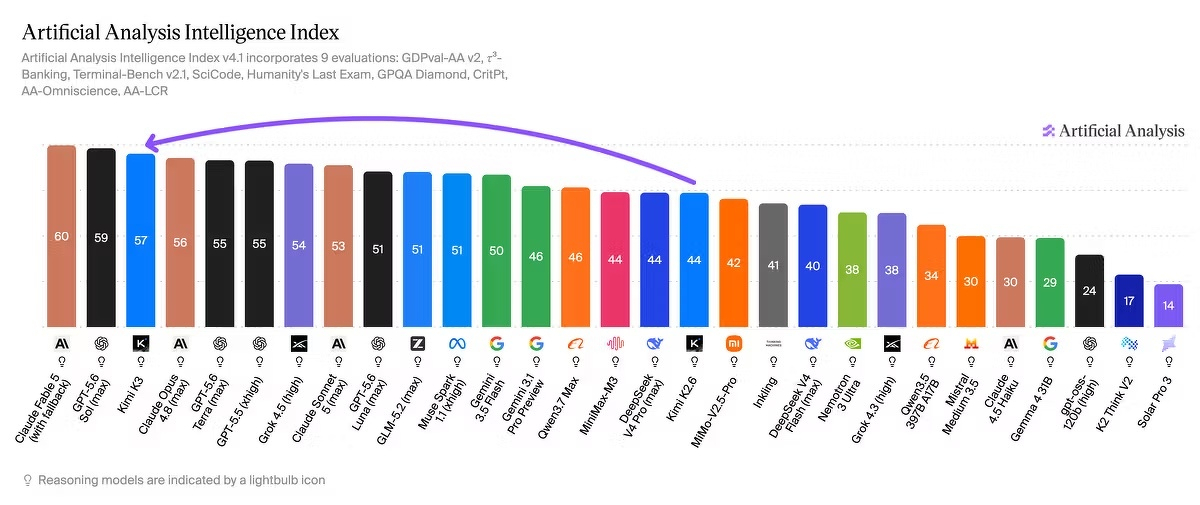
Six labs now field a model scoring above 50 on the Artificial Analysis Intelligence Index. Two months ago it was two. Grok 4.5, GPT-5.6, Muse Spark 1.1 and now Kimi K3 all launched within eight days of each other. The newest entrant landed this week, it’s Chinese, and it undercuts Claude on price.
Moonshot AI’s Kimi K3 is the first open model to reach 2.8 trillion parameters, built on a new attention mechanism called Kimi Delta Attention plus a sparser mixture-of-experts setup that activates just 16 of 896 experts per token. It carries a 1 million token context window and takes text and image input, though output stays text-only. On the Artificial Analysis Intelligence Index it scores 57, third overall behind only Claude Fable 5 (60) and GPT-5.6 Sol (59). It edges out Claude Opus 4.8, which sits one point behind at 56.
Cheaper than Opus, still not cheap
Line the three up and the pricing tells its own story. Kimi K3 runs at $3 per million input tokens and $15 per million output tokens. Claude Opus 4.8 is $5 and $25. Claude Fable 5 sits at $10 and $50. Kimi undercuts Opus by 40 per cent and Fable 5 by 70 per cent, on paper at least, while outscoring Opus on the industry’s leading composite benchmark.
That framing understates what has actually happened to Moonshot’s pricing. Kimi K2.6, the model K3 replaces, ran at $0.95 and $4. This is not a discount release. As Simon Willison points out, $3/$15 puts Kimi K3 in the same tier as Anthropic’s Sonnet series, and makes it the most expensive model any Chinese lab has shipped to date.
Artificial Analysis measures this a different way, cost per completed task rather than per token, and the gap holds up. Kimi K3 averages 94 cents a task, against $1.80 for Opus 4.8 and $1.04 for GPT-5.6 Sol. It is still well above open-weight peers GLM-5.2 (32 cents) and DeepSeek V4 Pro (4 cents). Cheaper than Claude, in other words, not cheap.
Strong at the front, patchier further back
Where K3 is genuinely dominant is frontend work. It took #1 on Arena.ai’s Frontend Code Arena with 1,679 points, ahead of Fable 5 on 1,631 and GPT-5.6 Sol on 1,618, winning six of seven categories and losing only Gaming to Fable 5. K2.6 sat at #18. That is a genuine jump, not a rounding error.
The picture is less clean elsewhere. On Artificial Analysis’s private agentic knowledge-work evaluation, K3 reaches an Elo of 1,547, second only to Fable 5. On real-world task completion (GDPval-AA v2) it hits 1,668, ahead of Opus 4.8’s 1,600 but well behind Fable 5’s 1,760. And accuracy improved unevenly: on the AA-Omniscience benchmark, correct answers rose from 33 per cent to 46 per cent between K2.6 and K3, but the hallucination rate rose too, from 39 per cent to 51 per cent. A model that is more often right and more often confidently wrong is not a straightforward upgrade.
Open weights, not yet
Here is the part that gets glossed over in most of the coverage. Kimi K3 is not currently an open-weights model. It is an API-only release. Moonshot says the full weights ship by 27 July, more than a week after the model itself launched. The licence terms haven’t been published either. K2.6 used a modified MIT licence with a monthly-active-user clause on large commercial deployments; something similar is a reasonable guess for K3, but it is only a guess.
And when the weights do land, running them yourself is its own barrier. Based on how the K2 family scaled, a usable local build is likely to need somewhere between 650 gigabytes and 1.7 terabytes of combined memory, depending on quantisation. No consumer machine gets close. The realistic floor is a multi-GPU workstation or a server with a terabyte of RAM, which is a rack line item, not a desk item.
None of that makes the release meaningless. Open weights still reshape the market even for people who will never download them: any host with the hardware can serve the same model, margins compress, nothing gets deprecated on a vendor’s schedule, and organisations get to choose their own jurisdiction for inference instead of accepting whoever’s terms of service. Those benefits arrive on 27 July. Right now, “open-weights” is a label attached to a promise.
The panic is premature
Axios called the release a moment that “erased America’s AI lead.” It landed the same day Xi Jinping opened the World AI Conference in Shanghai doubling down on China’s open-source strategy, which made the geopolitical framing irresistible.
Transformer’s Shakeel Hashim makes the more useful point: by Moonshot’s own admission, K3 is not at the frontier, and the UK’s AI Security Institute has found open-weight models running four to seven months behind the frontier on cyber tasks, an analysis that predates K3 but covers the same class of model. The reason China can afford to open-source at this level is precisely that the model isn’t dangerous enough yet for the calculus to change. Once a Chinese lab does reach genuinely frontier capability, expect the open releases to stop. There’s already reporting that Beijing is weighing restrictions on exactly that.
The gap between open and closed is genuinely narrowing, and the price of near-frontier intelligence is genuinely falling. What isn’t true yet is the “open” part. Come 27 July that changes, and the interesting question stops being whether Kimi K3 is good enough. It becomes who can actually afford to run it.
Sources
- Kimi K3 achieves #3 in the Artificial Analysis Intelligence Index - Artificial Analysis
- Four frontier launches in eight days - Artificial Analysis
- Kimi K3 - API Pricing & Providers - OpenRouter
- Claude Opus 4.8 - API Pricing & Benchmarks - OpenRouter
- Kimi K3 quickstart guide - Moonshot AI
- Kimi K3, and what we can still learn from the pelican benchmark - Simon Willison
- Can you run Kimi K3 locally? The 2.8T hardware reality - ModemGuides
- Kimi K3 is no reason for China panic - Transformer, Shakeel Hashim