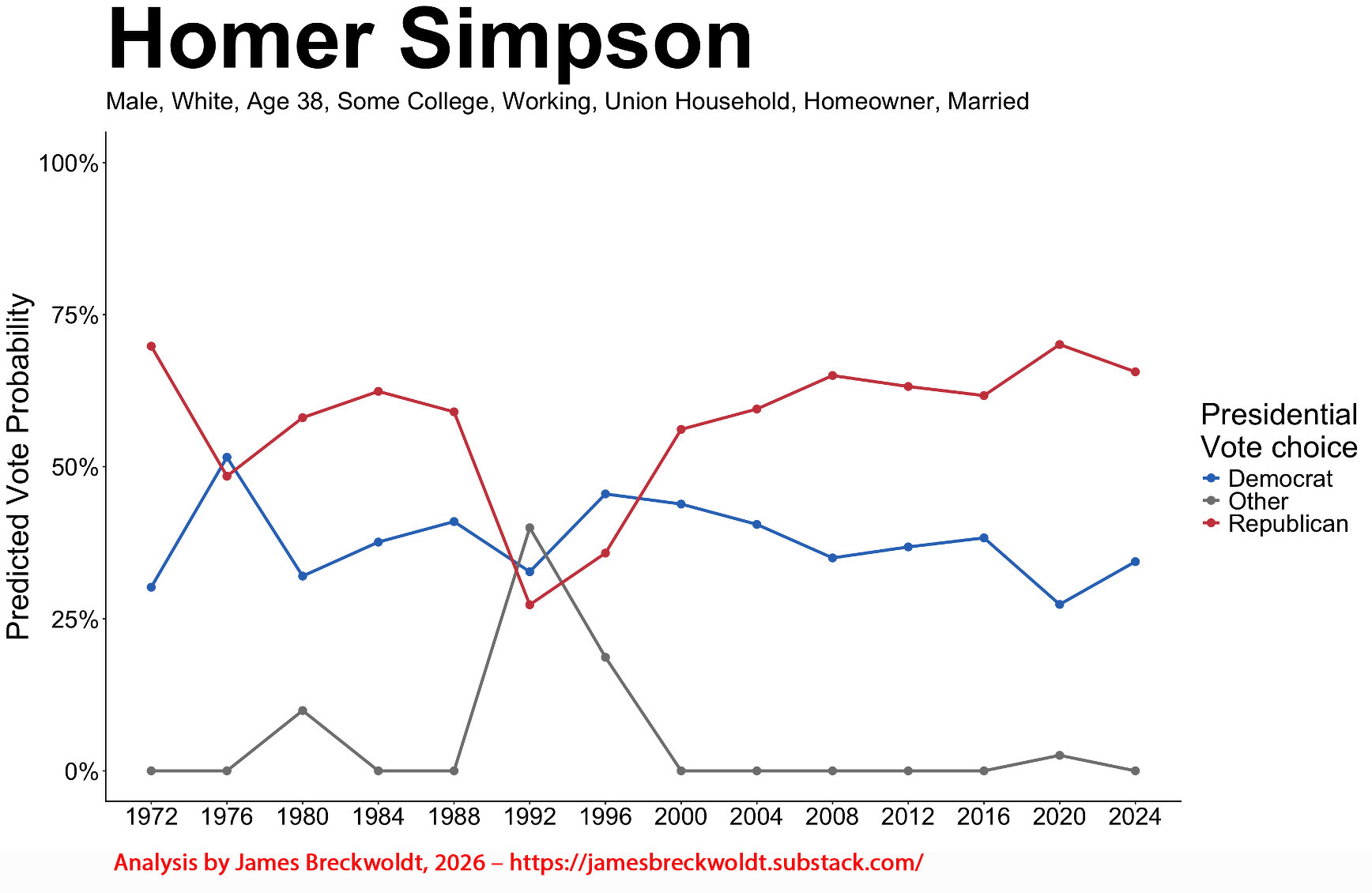
Homer became a MAGA voter - why?

That’s the question posed by James Breckwoldt in a fascinating study that uses Simpsons characters as archetypes to analyse changes in US society. This is not a matter of judging right or wrong, left or right. It’s a useful framework for understanding political realignment.

Breckwoldt uses American National Election Studies (ANES) data to model how characters from The Simpsons would have voted in every US presidential election since 1972. The Simpsons have been running for 36 years now. A lot has changed in that time.

Continue reading →


Political education in 15 second grabs

More Australians now access their news via social media than through traditional outlets. For young Australians, the shift is sharper still. The 2025 Digital News Report confirms they are increasingly drawn to video news on TikTok and Instagram. This is where political views are being formed. In The Age, former Liberal Party MP Lucy Wicks recounts a moment that brought this home. During a car ride, her nearly-17-year-old son Oscar told her that “socialism sounds pretty good.

Continue reading →


Someone turned Apple’s most annoying bugs into a scoreboard (9to5mac.com) Developer creates scoreboard tracking Apple’s most annoying bugs, highlighting wasted human time. Tracks issues like iCloud sync problems, iOS keyboard glitches and macOS Finder crashes.

Over 175,000 publicly exposed Ollama AI servers discovered worldwide - so fix now (techradar.com) Cybersecurity researchers discover over 175,000 publicly exposed Ollama AI servers globally, urging immediate action to address the vulnerability and secure these systems.

AI in the workplace: Some businesses embrace AI agents, others find human-led service better (theage.com.au) Businesses grapple with AI adoption in customer service. Some, like Sarah’s company, trial AI agents but find human-led service more effective. Others, like a mortgage broker, embrace AI to streamline operations and enhance customer experience.


OpenClaw: promise, peril and patience

It’s the last week of January 2026 and the AI world is moving at Lenin’s pace: weeks where decades happen. The latest object of fascination is OpenClaw, an autonomous AI agent that’s captured the imagination of the technically adventurous. It’s had three names in a week (ClawdBot, Moltbot, now OpenClaw). That velocity tells you something about where we are.

Continue reading →


Mind blowing to recode by sketch

I wasn’t happy with some of Felix’s visual layout. Felix is built with a web browser front end. This means a redesign involves hacking a lot of HTML, CSS and perhaps javascript. Underneath the surface websites are often a messy collection of complex code. CSS - cascading style sheets - have caused many a front-end developer to tear their hair out.

Instead I sketched my change requests on a screenshot. Gave it to Claude Code.

Voila. Minutes later I had a fully implemented and working re-design. Amazing.


Passion, madness and one more try

Claude Code told me to go to bed last night. I did not go to bed.

Auto-generated description: Instructions for fixing a search route issue are followed by a reminder to GO TO BED! with an emoji.

This is not a story about artificial intelligence developing unexpected emotional intelligence, though it did cross my mind. It’s a story about the strange territory between caring deeply about something and caring too much. And how difficult it is to know, in the moment, which side of that line you’re standing on.

Continue reading →


Behind the Scenes: Building Felix with Claude Code

This is the technical companion to my earlier post about building Felix, my personal bookmark manager. That post covered the why and what. This one covers the how.I’m not a developer, so these choices came from conversations with Claude Code about what would work best for a local-first personal tool.

Continue reading →


Building Felix: From RSS Chaos to Organised Bookmarks in 6 Hours

Yesterday I built an app. My first ever, not counting some AppleScripts and HyperCard stacks back in the day. I scoped out the requirements during a 10-minute walk, dictating into my iPhone. After running errands I cleaned up the notes at my Mac, fired up Claude Code, and had a working application by evening.

The name comes from Felix the Cat and his “Magic Bag of Tricks” - classic Aussie made cartoon.

My Felix magically collects bookmarks from various sources and transforms them with AI assistance.

Continue reading →


Bruce Springsteen sings from his heart. Spot on.

Poster

Talent and modern tools deliver the fastest protest song in the west.

Bruce Springsteen:

I wrote this song on Saturday, recorded it yesterday and released it to you today in response to the state terror being visited on the city of Minneapolis. It’s dedicated to the people of Minneapolis, our innocent immigrant neighbors and in memory of Alex Pretti and Renee Good.

Stay free, Bruce Springsteen


My first experiments with Claude Code

Late last night I installed Claude Code. Early this morning I extended my first script from the couch, before coffee. The gap between those two moments tells you something about where software coding is heading.

Claude Code is, essentially, Claude AI living in your Terminal. For those who haven’t ventured into the command line, Terminal is your Mac’s text-based interface, where you type commands instead of clicking buttons (Windows PCs have something similar). I have basic skills in Terminal (enough to navigate without breaking things) but I can’t code. Specifically, I can’t write Python, which is one of the simpler programming languages Claude Code uses to build applications. Python is popular because it’s readable and versatile, powering everything from web apps to automation scripts. I know what it does. I just can’t write it myself.

Or couldn’t. The distinction matters now.

Continue reading →