Posts in: agents


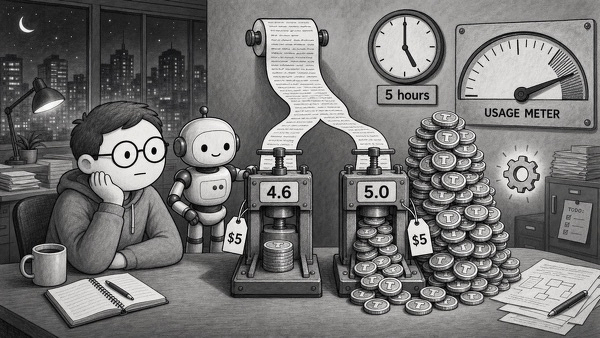
The frontier is a tax

TL;DR - The most powerful AI models from Anthropic (Claude) and OpenAI (GPT-5.5) are no longer clearly ahead. An open-weight challenger, Z.AI’s GLM 5.2, now matches the priciest flagships, beats Anthropic’s mainstream workhorse outright, and costs a fraction as much. At the same time the closed labs are quietly ending the all-you-can-eat deal on their heaviest models and moving to pay-per-use as they chase profit. If you pay for the top tier out of habit, now is the moment to check whether you still need to.

A quick orientation for anyone who does not live in this stuff. “Frontier” models are the biggest, most capable AI systems, the ones the headlines are about. Anthropic’s Claude Opus. OpenAI’s GPT-5.5. They are closed: you rent access, you cannot see inside them, and you cannot run them yourself.

“Open-weight” models are the opposite. The company releases the actual model so anyone can download it, run it on their own hardware or host it cheaply through a dozen competing providers. Z.AI’s GLM 5.2 is one of these.

Continue reading →


Cowork read its own logs and wrote me five new skills

I read Austin Henley’s post Automating my job away on a Friday night and did the laziest possible thing with it.

Henley’s whole piece builds to one prompt. A friend who runs a startup tells his team don’t do anything three times - if a task comes round more than twice, automate it. Henley took that to its logical end and pointed his coding agent at its own history.

So I copied his idea, swapped “Copilot” for “Cowork”, and pasted this in:

Continue reading →


Apple puts you at the centre of AI

At WWDC 2026 this week, someone asked Siri to go through a folder of contractor quotes as PDFs, compare them, pick the best option and draft a reply email. Siri did it. Live, on stage, in front of an audience.

That’s not a kitchen timer. That’s not “Hey Siri, what’s the weather.” That’s the kind of task you’d currently hand to Claude or ChatGPT with careful prompting and a bit of luck. Apple just demonstrated it happening through a voice assistant most of us had written off.

It is worth understanding how they got there - because the architecture behind it is genuinely interesting, and a lot of it comes down to a clever solution to a very unglamorous problem: memory.

Continue reading →


Microsoft just made Windows the agent operating system

Microsoft’s annual developer conference, Build, kicked off at 3am Melbourne time on Wednesday. I didn’t stay up to watch - but I’ve absorbed the media releases and technical docs, and there’s a genuine shift happening here that’s worth unpacking.

TL;DR for the non-technical: AI assistants are about to get much more capable, but that creates a trust problem - how do you let a smart assistant do things on your computer without giving it the keys to everything? Microsoft just announced that Windows itself will act as the security guard. It will control exactly what an AI assistant can see and touch on your machine, track what it does separately from what you do and run smaller AI models directly on your computer so your data doesn’t have to leave your desk. Think of it as giving your AI assistant its own office with its own keycard, instead of letting it wander freely through yours. The catch: it needs newer, more powerful hardware to work properly, and most of it isn’t shipping yet.

Now, the details.

Continue reading →


What a Singapore minister's AI setup can teach you

Singapore’s Foreign Minister assembled a personal AI agent on a Raspberry Pi 5 with 8GB of RAM. He hasn’t dared switch it off in three months. He is not an engineer.

That’s the story. But the interesting part is what he learned building it - and why he built it at all.

Dr Vivian Balakrishnan gave a 22-minute talk at AI Engineer Singapore on 16 May. He described himself as a practitioner with a day job - “a retired eye surgeon who took a detour into politics, perhaps for too long.” The talk is worth watching in full. His framing of what AI agents are actually useful for cuts through more noise than most conference keynotes manage.

Continue reading →


What running AI agents actually costs

I wanted to know if my AI subscription was earning its keep. So I repriced 30 days of real usage at pay-per-token rates and compared it to what I actually pay.

The answer: $96 USD equivalent in tokens consumed. My subscription costs $100 USD a month. That’s not a rounding error - that’s a subscription running at near-full utilisation.

Not a prototype. Not a weekend experiment. A system I actually depend on - morning briefings, task management, research, document work, health tracking, portfolio analysis. The Autonomi, as I call it, runs continuously and does real work.

Continue reading →


The pathfinder finds the cliffs

Another week, another claimed breakthrough - this one called OpenHuman.

It lives in an avatar, has a voice and can join your Google Meet as an equal - “joins meetings, transcribes them into your Memory Tree, and can speak back into the call.” The pitch is that it is “an open-source AI assistant designed to be the memory and doer for everything you do across your tools.”

It ticks a lot of boxes. It promises all the right things. It is very tempting.

Continue reading →