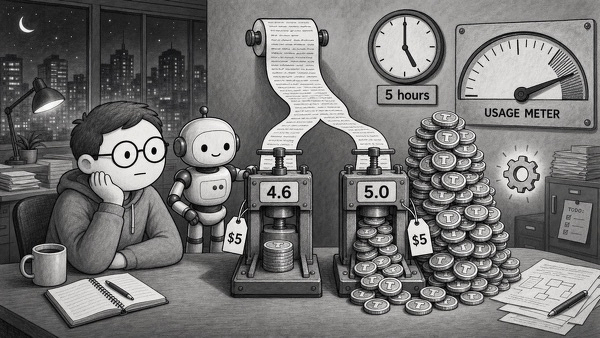
The same code file now costs 30% more to process than it did three months ago. The price per token didn’t change. The tokenizer did.
Anthropic’s post-4.6 models - Sonnet 5, Opus 4.8, Fable 5 - use a new tokenizer that cuts text into more pieces than the 4.6 generation did, and you pay per piece. A detailed analysis by Playcode, who measured every frontier tokenizer on identical files, found the new Anthropic tokenizer produces 1.36 to 1.73 times GPT’s token count on the same content. TypeScript is the worst case at 1.73x.
The sticker price is unchanged. The effective price is not.
The numbers Anthropic doesn’t print
Run the arithmetic and “upgrading” looks less like progress. Opus 4.8 lists at $5 input / $25 output per million tokens - identical to Opus 4.6. But the new tokenizer turns the same codebase into roughly 32% more tokens. Effective rates: $7.50 / $37.50. Sonnet 5 carries a $3 sticker after its August introductory window closes - with the new tokenizer, it behaves like $4.50.
Sonnet 5 is actually an instructive case study in how this works. The $2 intro price was designed to look like a cut. It very nearly covers the tokenizer inflation - but only until August 31. After that the sticker snaps back to $3 while the +32% token count stays. The discount was a transition cushion, not a durable saving.
None of this appears in Anthropic’s pricing documentation.
There is a second compounding factor. Claude Code burns roughly 33,000 tokens on system-prompt overhead before it even reads your first message. That is just the entry toll - every conversation starts in deficit. On the new tokenizer, that toll is 32% heavier than it used to be.
If you are hitting your 5-hour or weekly quota limits more often than a few months ago, you now know why. You are not using Claude more. Claude is using more tokens.
GPT is pulling ahead on cost per task
While Anthropic has been adding tokens, OpenAI has been holding the line. Playcode verified GPT-5.6 Sol against the live API and confirmed it uses the same lean o200k tokenizer as GPT-5.1 and 5.5 - zero inflation, no hidden multiplier. The table is not flattering for Anthropic.
At identical sticker prices - both $5 input - Opus 4.8 effective cost is $7.50 while GPT-5.6 Sol stays at $5.00. On output, Anthropic’s $25 becomes $37.50 against OpenAI’s $30. And this is before accounting for capability: one production team migrating from Opus 4.8 to GPT-5.6 Sol reported using 1.70M tokens against 2.60M for the same builds - 35% fewer, on real invoice data, not a synthetic benchmark.
Grok 4.5 and Gemini 3 Flash both run close to the GPT tokenizer efficiency. Gemini 3 Flash at $0.55 effective input is extraordinary value. The field is leaning in one direction while Anthropic’s tokenizer leans the other.
This is direct competitive pressure. If OpenAI is matching or exceeding Claude’s quality on reasoning tasks while undercutting it on effective cost per token, Anthropic faces a real problem - particularly with developer and power users who instrument their costs carefully.
The opacity problem
SmartFriend™️ Peter Marks noticed he was running into quota limits more frequently. When I flagged the tokenizer change, he put his finger on the second issue: “I read something about them sending far more tokens up on initial query. Hard to know why they’re doing this - benchmarks better perhaps?”
That is the charitable read. The less charitable one: more granular tokenisation can improve scores on standard benchmarks. If Anthropic is optimising for the leaderboard rather than the user’s bill, there is no mystery - there is just an incentive problem.
Simon Willison documented the tokenizer change in April when it shipped. Anthropic quietly increased usage limits at the time to soften the blow. But none of that was announced, and limits can be wound back just as quietly. There is no mechanism for users to know when that happens.
I trust Anthropic to look after themselves. I trust them to optimise for profit. I don’t trust them to look after their users. Unless there is sustained backlash, there is no incentive for them to change course.
What to do
The practical response is simple: explicitly select a 4.6-era model and stop accepting the default.
In Claude apps, set your preferred model to claude-sonnet-4-6 or claude-opus-4-6 in Settings. In Claude Code, add "model": "claude-sonnet-4-6" to your .claude/settings.json. The default in most interfaces points at the newest available model - which is now the most token-hungry one.
I run Sonnet 4.6 as my daily driver and Opus 4.6 for heavier reasoning. Both handle everything I actually do: writing, analysis, code review, research. The 5-generation models improve on things I have no use for - 3D simulation, protein folding, solving decades-old mathematics problems.
Have I reached maximum satisfaction? Possibly. At this point I want the same quality delivered faster and cheaper. The 4.6 models do that. If OpenAI keeps closing the quality gap while Anthropic’s effective costs keep rising, that calculus may eventually point somewhere else entirely.
For now: the fix takes thirty seconds. Set it once and stop bleeding tokens.
Sources:
- The real price of frontier models - Playcode (Ruslan Ianberdin)
- Migrating a production AI agent to GPT-5.6 - Ploy
- Claude Code burns 33k tokens before it even reads your prompt - Ashraf Chowdury, dev.to
- Claude token counts - Simon Willison