Nobody wants to be a model selector.
Most people do not want to decide whether a task deserves Fable, Sol, Opus, Sonnet or Haiku. They want the job done properly, quickly and without the invoice arriving as a small technical mystery.
That is where Token Blending comes in.
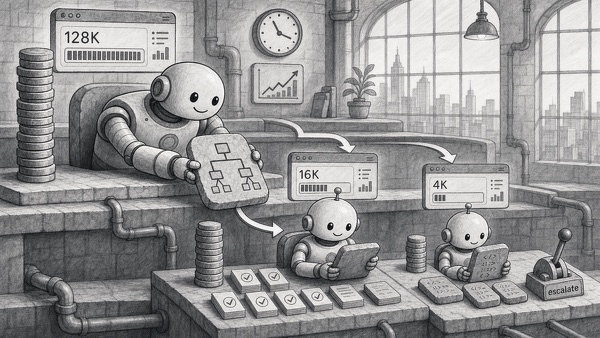
The idea is straightforward. Start an agentic task with the biggest, smartest and most expensive model. Let it understand the problem, make the difficult calls and create the plan. Then hand the defined work to a cheaper, faster model to execute.
Use frontier intelligence where it matters. Use cheaper intelligence where it does not.
This is not a theory. It is already happening.
Anthropic’s Claude Code has a built-in setting called opusplan. Opus does the planning. Sonnet does the execution. The handover keeps the conversation intact, so the cheaper model can see what the more capable model decided and get on with the work.
Anthropic’s advice is unusually blunt: the highest-value use of Opus is writing the plan. A good plan can prevent a bad 400-line code change, a revert and another expensive attempt to explain what went wrong.
That is the first form of Token Blending. Big brain first. Workhorse second.
Anthropic has also built the inverse version into its API. Its advisor strategy lets a cheaper executor run the task, then call Opus only when it hits a decision it cannot reasonably solve. The expensive model provides a short plan, correction or stop signal. The cheaper model carries on.
This is clever because it moves model choice from the person to the system.
The agent does not ask, “Would you like to spend more?” It notices that the task has become hard, buys a small dose of frontier reasoning then returns to the cheaper lane.
That is what a properly mature AI product should do.
Not every Anthropic product has caught up yet.
Take Claude Cowork. For all my regard for it, model selection is a one-time decision: you pick a model at the start, and you are locked in for the duration of the task. If you want to blend manually, you run the planning session with a frontier model, copy the output, then open a second session and choose a cheaper model for execution. It works. It is also clunky and sub-optimal in a way that good product design should not require.
The bolder version crosses company lines.
Every.to recently described a workflow where Anthropic’s Fable 5 acts as the orchestrator and OpenAI’s GPT-5.6 Sol executes the plan. Fable gets the big, ambiguous assignment. Sol does the day-to-day building.
It is a useful split. Every’s team sees Fable as the model for long-horizon work where planning, judgment and decision-making are a large part of the assignment. Sol is the fast, steerable collaborator that can move through execution without making the user wait around.
The important point is that this is not yet a magical cross-vendor button. It is a workflow designed by people who know the strengths of both tools.
But it points directly at where the market is heading.
OpenAI and Anthropic are in the best position to make Token Blending normal because each already has a family of models at different price and capability levels. They own the frontier model, the cheaper model and increasingly the agentic workspace where the handoff can happen.
The business incentive is obvious. If a provider can get 90 per cent of the outcome for 50 per cent of the cost, it can offer a better deal without giving away all of its margin.
The consumer benefit is obvious too. You stop paying frontier-model prices for routine work.
The complication is that the economics of AI get much harder to understand.
Today, token pricing is already an awkward proxy for value. Most people have no idea how many tokens a research project, a software change or a marketing campaign should consume. They care about whether it worked.
Token Blending makes that even murkier. The final bill may include planning tokens, execution tokens, context transferred between models, tool calls, retries, verification passes and perhaps an escalation to a more capable model after the cheap one gets stuck.
The price of a token matters less. The cost per completed task matters more.
That is a much better metric. It is also much harder to inspect.
An agent that quietly routes work across models could be a brilliant deal. Or it could become the AI equivalent of a phone plan with fifteen different charges hiding behind the headline price.
The winners will make the blend visible. They will show which model did what, why it was chosen, what it cost and whether the result passed verification. The losers will make the whole thing feel like a black box, then call it simplicity.
Token blending works because it treats intelligence as something to allocate, not a product to worship.
The next AI agent will not have one brain.
It will have a brain trust - and the best ones will know when not to call the most expensive person into the room.
Sources:
- Models, usage and limits in Claude Code - Anthropic
- The advisor strategy: Give agents an intelligence boost - Anthropic
- Vibe Check: GPT-5.6 Sol Is Our Favorite Model to Collaborate With - Katie Parrott, Every