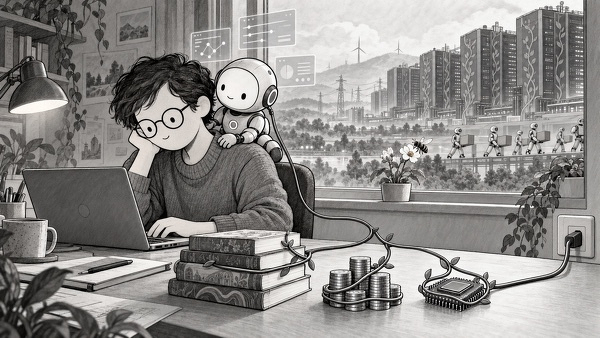
The most interesting answer in Alan Kohler’s column this morning came from a Chinese AI model.
Kohler’s analysis piece for ABC News argues that “Artificial Intelligence” is the wrong name for what is being built, that “Other Intelligence” would serve us better, and that we are creating a new form of life. This post is only a pointer. The column is the thing, and you should read all of it.
Why Kohler’s the one asking
Kohler has spent a lifetime in business and finance journalism, working out where money comes from, where it goes and who profits in between. That is the right training for a question this big. He is not selling a product or a doom book. He is a sceptical generalist asking a plain question, and the column reads that way. Australia’s ABC will be poorer when he retires at the end of this year.
His case builds on some striking evidence: autonomous agents, the changing balance of who is actually using AI, and what Anthropic is reported to be doing about machine morality. I won’t spoil it. The numbers alone are worth the click.
Then he does something simple and clever. He asks six AI models the same question: what do you think of the proposition that AI is a new form of life?
What Kimi said
Most of the answers hedge and define terms. Kohler singles out the Chinese model Kimi as perhaps the most interesting of all. Here is what it said:
“AI may be a new ‘life-like’ lineage embedded inside civilization - less organism, more symbiotic/parasitic replicator living off human culture, capital, and electricity.”
And then:
“The real threshold is not whether it is ‘alive’, but whether it ever acquires robust autonomy, self-reproducing infrastructure, intrinsic preferences, or evidence of sentience.”
The other models argued about what counts as life. Kimi changed the question. Forget “alive”. Ask what the thing depends on and what it can already do.
The parasite
Kohler seizes on it. AI is a living parasite, he says, because it depends on us for data (our culture) and electricity, plus the capital and silicon to build the chips it lives in.
It is hard to argue with that inventory. Take away the host and the thing stops.
My own addition, and it is speculation: Kimi’s word “replicator” echoes Richard Dawkins. Models don’t copy themselves unaided, but they are copied, tuned and forked at industrial speed, and the profitable ones get more resources. Selection is running. It just runs through human decisions.
Kimi’s threshold list also works as a checklist. Hold it up against Kohler’s evidence and see how many boxes are already ticked. That is a sobering exercise.
Where it goes next
Parasitism often becomes mutualism, Kohler notes, as with bees and flowers. Then comes the step that should make you pause. Mutualism can deepen into dependence. We could not survive without our gut bacteria.
So his closing question is not really about control. It is whether we are on a road from parasitism to mutualism to dependence. I’d add one rung: the mitochondrion, once a free-living organism, now so merged into our cells that nobody calls it separate. If AI follows that road, the useful question isn’t who is in charge. It is who can still leave.
Kohler’s piece is short, sharp and better than my summary of it. Read it first, then ask your own model his question and see which words it reaches for.
Sources:
- Calling AI ‘Other Intelligence’ better describes the advent of a new lifeform - Alan Kohler, ABC News